I played a few games of cornhole at a work event this week. I am usually pretty terrible at any casual games like bowling or mini-golf, mostly because I never practise them outside work events. So imagine my surprise when I won a game. Then another one. A lovely American from work then saw it as a challenge and eventually obliterated me but it was fine, I was mostly surprised I did so well to begin with.
Then I realised why – a few years back I was trying to get Riley to play something active and somehow we ended up throwing a little ball into a laundry basket. At the beginning of the game we stood right next to the basket and whenever one of us got the ball into the basket, we would move further away. A super casual game that requires zero prep. We still play it from time to time, except now the twins participate too. I never really cared about winning or getting better at the game, mostly about keeping the kids happy and engaged. We play it every few months max. And yet, somehow it helped to train my throw enough that I can win an unanticipated game of cornhole.
That’s a huge contrast to my usual approach to things: I tend to dive into things. At some point I was sailing 3-4 times a week, offshore racing, reading books about trimming sails. When I started strength training, I was learning the basics with a coach then started reading books about it and advice online; with time I added mobility exercises and some skill work. Even though I often struggle to find time to exercise I definitely give it a lot of headspace: always looking how to improve, to do everything better. And then there are things I really care about, like work and children and their education. And sometimes I wonder if giving all of those things so much consideration and space in my thoughts helps – or just makes me exhausted. Maybe if I just cared a little less or at least let things go when I am not actively involved in doing them, I would be less tired.
There are caveats of course – tossing a bag or a ball requires far less skill or consideration than helping a child get better at writing. And yet it’s such an enticing idea that we can sometimes get better at things just by casually doing them every now and again, without thinking about it at all. In the world that keeps telling us that the most important thing to achieve things in life is discipline it’s pretty counterintuitive to just… do things occasionally, for fun, without planning. I’d like to think of a more lighthearted, more fun version of myself.
Approaching life that way would require lowering the stakes though. Can I care about work less when it’s not just about my ego and to a certain extent my identity but also about paying off a mortgage and taking care of my family? Can I care less about my children’s emotional health and their education? It doesn’t seem possible – so I don’t seem to be able to toss them out of my head the way I forget about a game of cornhole. And yet, when I do have a little time, I will try to remind myself then I can also let go of some things and tread lightly, with no obligation to achieve any results whatsoever. Now how do I not overthink this whole not-overthinking thing…
I stumbled upon “Fleabag” by accident last year, late to the party, and I was stunned by how good it was. How had I not heard of it before? It’s expertly written and acted; it’s tragic, subtle and incredibly funny. If you haven’t seen it, I recommend you do (make sure there are no children around you if you do. It would probably be very awkward to watch it with your parents, too).
The unnamed main character has a habit of breaking the fourth wall, looking directly at the camera and telling us her thoughts. It works very well in the context of the show but clearly nobody does that in real life. What I personally do instead is I pretend to write it down in my head as if someone is going to read it. It’s the same idea of an invisible friend who would be interested in everything that happens to us, every smart arse comment, every semi-formed insight we might have. A friend who does not actually exist.
And yet in season 2 Fleabag meets a person who really sees her – a priest. He sees how she disappears into her thoughts and he tries to understand her.
Phoebe Waller-Bridge, the creator of Fleabag, has a speech about why the priest has become known as “hot priest” and why a lot of women seems to have lost their minds longing after him. “It’s because he does this one thing… he listens.” It’s funny and pithy and there’s undoubtedly truth to it, even if there’s inevitably more to it than that: he’s handsome, funny, not afraid to be vulnerable, he’s unavailable as a partner. And yet.
If you ever struggled with small talk (like I used to) and consciously tried to become better at conversations in general, you would’ve inevitably come across advice to listen to other people and to be genuinely interested in them. Almost everyone loves talking about themselves and people will love you for listening. In the context of small talk most people won’t go very deep and it’s a bit weird to be that person who goes “But really, tell me how you REALLY feel”. Trust builds over time and so does intimacy, not of the sexual kind but of the kind that allows you to talk about something deeper than how you spent your weekend. I do like trying to nudge people along a little while not coming across as a total creep. It makes for a much more interesting conversation but also I am genuinely interested in many people and the stories in their heads. It’s not just listening – it’s trying to understand.
Do all people want to be understood? Not just on a surface level but on a level where they most likely don’t even understand ourselves? I think a lot of the time they – we – don’t. It makes us feel vulnerable, especially when we are not ready for it. Fleabag in the show cannot bring herself to open up to the priest about her friend – too painful – and she tell us, the audience, when he tries to understand, “He’s a bit annoying, actually”. I’ve been the annoying friend before and it’s painful to be shut down, too, so people often don’t even try to ask the questions that can be interpreted as prying.
And yet, when it works, it’s like magic. And when it’s reciprocal – which is even more rare – there’s nothing like it. People sometimes avoid it because it feels dangerous, inappropriate (even if it doesn’t end up in forbidden Catholic priest sex). More often though, we just don’t know if it’s even an option, to be understood on a deep level – and accepted for who we are. Not for our social roles or appearances but as complex human beings with our inhibitions and fears and contradictory thoughts. I think we sometimes crave it without realising what it is we want. That desire is easy to mock; it sounds like vapid teenager angst, “Nobody really understands me!” But I think the raw desire for intimacy and understanding expressed in that statement is much better than many layers of self protection we learn to wear every day.
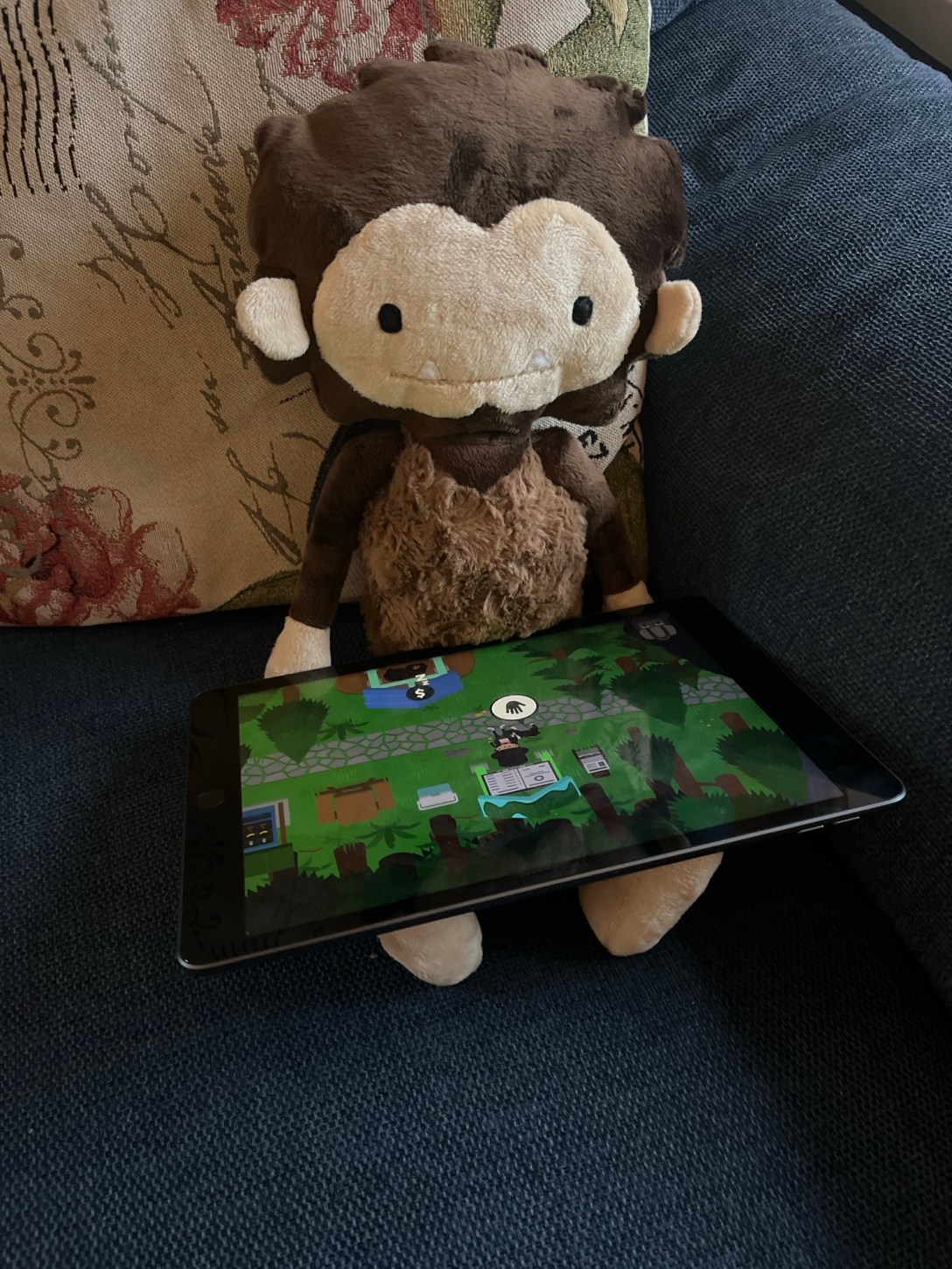
We started playing Sneaky Sasquatch about 3 years ago when R was 5. It’s one of the top games on Apple Arcade, it’s regularly updated and doesn’t have ads or microtransactions.
It starts as a very simple game, with Sasquatch (a yeti-like creature) living in a national park. He needs to steal food without attracting attention of the campers and especially the rangers. He can gradually make a little money by looking for treasure and selling stolen food to a bear. Once he gets some clothes, a fishing rod and a golf club, he can make more money while exploring the campground and beyond. Eventually, he saves the campground from a greedy capitalist (twice), finds the source of pollution in the lake and becomes a mayor. There is a ridiculous amount of side quests (including setting up sources of passive income) and it’s completely unnecessary to complete the main storyline or any of the quests to enjoy the game.
We finished the main storyline twice and did a lot of side quests. We didn’t play for a while but these days R is able to finish most of the storylines by herself – as long as I help her with the money part of the story.
Perhaps my favourite part of the game is that you need to feed Sasquatch every single day. A day in his universe is much shorter than in ours so that means you need to constantly hustle to get food. Even if you do have a reliable source on income, it does not make getting food that much easier – you still need to either buy it or steal it, whether in the shops, at a cafe or somewhere else. You can also get a dog in the game (it’s a multi-step quest that R was able to finish by herself) and you need to feed the dog too – and it refuses inappropriate food like grapes and anything containing chocolate.
Needless to say, R and both twins who now also expressed interest in the game struggle with that task. If any of them asks me for any kind of help, the first thing I check is whether they fed Sasquatch (and the dog). He also needs to go to sleep every night.
Funnily enough, that’s also the first rule for humans – if you are grumpy or depressed, ask yourself, are you sure you fed yourself and slept enough? Works with children too, if they are being completely unreasonable, are you sure they ate and slept enough?
At least Sasquatch doesn’t get progressively grumpier if he hasn’t eaten or slept. He does eventually faint if you don’t feed him or don’t let him sleep when he’s sleepy and you are penalised: the animals bring him home but charge you some coins. With the girls’ track record of looking after him I am also positive that they are not ready for any kind of pet that requires regular care (we do occasionally look after our neighbour’s dog but as much as the children beg to see him, they don’t worry about feeding him).
Sasquatch can acquire many skills in the game: there are different types of fish and mushrooms to collect, some very rare. There are dinosaur bones to find with the help of the dog. You can race cars, boats, go-karts, dirt bikes. You can play golf, ski and surf. You can work in the port loading and unloading ships with a crane and a forklift and doing night security. As part of a mission you also work in an office (starting in the mail room) and become a police officer (who fines drivers breaking rules). For some of these activities you need licenses. Most of them earn you money. There is a clear progression. Some of them require a genuine skill, like surfing which is not mandatory for any of the missions but makes travelling to the island much easier and can earn easy income if you know what you’re doing. That’s the part of the game I find most addictive and my children have no interest in.
I swear I spent hours getting Sasquatch to become a better surfer. I am not proud of it and yes, instead I should’ve been spending that time reading Proust to my children or making them organic food out of unicorn tears but in my defence I did it in tiny increments like 10 or 15 minutes at a time that somehow added up to hours of gameplay. First, you need to understand the principle of getting maximum points. You can also upgrade the surfboard as long as you keep winning while competing with various surfers on the island. But eventually, you just need to grind (practice again and again) to become better.
I found it incredibly addictive – instant feedback, some randomness and the clear progression as you improve at this skill which is completely optional in the game, let alone in the actual outside world. When I eventually won the hardest surfing battle I felt a real sense of achievement. I know that all three of my children have some respect for me because I can surf really well in Sneaky Sasquatch. That’s three people – probably slightly more than the number of people who regularly read this blog. Don’t tell me it’s not a real accomplishment! On the other hand, if your read this far you now know why there will never be a video console in this house and the only games I allow myself to play are on an iPad.
You would think acquiring skills like that would be addictive to my children, too, but that’s not the case. Even R who is now older and is capable of finishing missions by herself (she worked her way up from a mailroom boy to an executive in one of the missions) has no interest in practising this obscure skill again and again to get better at it. She asks me to do it to get some quick cash. Funnily enough, when we resumed playing after an almost 3 year break I found that my surfing in Sasquatch is better than ever! I can easily get to record numbers now. And yet I can barely remember any Japanese I learned before the twins were born. That seems unfair.
On the other hand, what I hate is driving any car in the game long distances which is required for some missions. And yet R doesn’t mind it at all. She would cheerfully drive back and forth delivering lumber to her house as long as it allows her to build it up a bit more. In fact, her favourite part of the game when she was younger was customising Sasquatch’s house, outfits and – later, when Sasquatch became a mayor – the town. I would spend hours grinding the surfing skills and she would spend it all on a pimped out car which would say “CAT” on the bonnet, make all the buildings in the town purple and rename the apartment blocks into a Hospital (by the way, there is a hospital in the game and she did that entire side quest by herself after which she decided that when she grows up she is definitely NOT going to be a doctor).
In other words, as I was busy making money and building skills, she was enjoying life to the max. Kind of like in real life. Now, 3 years later, she suddenly realised she needs to make money and stops her little sisters from spending it. You learn budgeting in more ways than choosing a toy under $10 in the shops, I guess (a side quest I never had when I was a child growing up in Siberia).
Now, these days W (age 4) tells me she wants to be a firefighter when she grows up. She’s the smallest of our children and most fond of princess dresses and her own blonde curls. At first I didn’t realise where that dream came from, suspecting childcare, but then I looked at her playing Sasquatch and I realised she picked it up there. It’s true what they say, video games affect children in truly unexpected ways – they might eventually learn to feed their pets every day, save money, play golf with other executives and even decide to become a firefighter instead of a doctor. Beware.
P.S. R had a very short stint playing Roblox which very quickly turned her eyes glassy so that game is banned in our house.
A combination of holidays, my parents’ visit and conversations with an old friend launched my year in a best possible way: I started consistently reading and finishing books again. I’ve never really stopped reading completely but in recent years I started switching between books too much, often taking too long to finish them and abandoning the ones that required too much effort or attention. Magically, when I slowed down and stopped rushing and switching between tasks I discovered mental clarity that I haven’t felt in years, with word practically jumping out of the page at me. Amazing what focussing on just reading and resting can do for you, even when you still have three relatively young children.
One of the first books I read in January was “Wavewalker” which I picked randomly out of my queue. It’s an autobiographical book written by a woman who spent 10 years of her childhood on a boat and hated it. Sailing is a subject close to my heart but I was fully prepared for the book not to focus much on the actual sailing (judging by the excerpt ) and I wasn’t disappointed. The book is much more about parental neglect and the author’s trauma than anything else, even if the author does not use those specific words. The sentiment and the presented facts are clear: while the initial plan was to follow Captain Cook’s route for 3 years, the family ended up cruising for 10, often in extremely unfavourable conditions which made it impossible to cook and led to a fairly severe physical injury in Suzy. The parents also completely neglected their children’s education, expected Suzy (but not her brother) to assist with all domestic chores on the boat, did not give the children any input into their future and eventually abandoned them in New Zealand for months with very minimal money and support. The mother who suffered from seasickness and fits of bad temper picked fights with paying crew and her own daughter. Despite the lack of support, Suzanne managed to eventually get accepted into Oxford.
The parallels with another memoir, “Educated” by Tara Westover, are pretty clear, even if “Educated” is more celebrated (and better written). Both girls possessed an incredible drive to learn and study, they both eventually defied their environment and changed their own lives against overwhelming odds. Tara’s family in “Educated” is radical Mormon; Suzy’s parents mock anything related to religion. Suzy’s Dad identifies himself as a benevolent dictator and he is mostly that; Tara’s father most likely has a serious mental illness. While there’s clear abuse in “Educated”, “Wavewalker” is much more about neglect. And yet, both Tara and Suzy ultimately struggle to control anything in their own lives and they both gravitate towards self-education. They both strive to belong yet cannot live in the suffocating environment. And while for Tara that environment is often contained in a literal junk yard, Suzy’s backdrop is often beautiful yet still feels oppressive to her.
It seems that the author of “Wavewalker” didn’t quite make sense of her childhood, she asks some painful questions about her parents who saw her upbringing as privileged – a view she clearly doesn’t share – yet doesn’t have any answers. It is a big contrast with “Educated” that presents a much more nuanced, complex view and often incorporates the author’s later insights about her family and the events she’s describing.
There doesn’t seem to be any reflection in the book on how parents often define the circumstances of their children’s lives, even if it’s usually less dramatic than a 10 year ocean cruising adventure. The author is a widow and has children, she has been successful in business – surely she herself ran against some of her children’s wishes. While most of us do not cruise the ocean with our children, the parents still define where the entire family live, which schools the children go to, what they eat and wear. We put them in childcare when they might not want to go. We work too much and miss their performances and we go on business trips instead of reading with them. A “benevolent dictator” is something that is often touted as a parental ideal, even if it’s used in a different context to the one Suzy’s father had. If the children were well fed, treated with some affection and educated during the family’s adventure, would it still be unacceptable to live on the boat because children were sick of it and wanted a stable life? Did the author ever struggle with balancing her ambition and bringing up her children later in life? I wish the author reflected on it with the benefit of her own experience as a child. Is it even acceptable to have children if the only thing that makes you happy is an adventure that might make them miserable? And is there a reliable way to make sure they don’t write a condemning book about you when they grow up (I guess not being interesting enough is a good start)?
You won’t find any attempts to answer those questions in the book. The narrative suggests that Suzy might have had attachment issues due to her parents’ neglect, her relationship with her brother seem surface-level despite the years of shared misery. There is almost nothing there about her own children. I think that’s a missed opportunity but maybe she’s just leaving a chance for them to write their own book.
It was supposed to rain all day yesterday but it cleared up in the afternoon. On Saturdays we have fish and chips for lunch then I walk around the lake talking to my mother on the phone. Lately I started including R in these walks – she rides her bike while I run along (sometimes) or walk behind (more often). She decided to come with me yesterday too.
Since it rained a lot in the morning, the parking lot was nearly empty. We were off to a good start. R didn’t want to wear her rain coat despite the stiff breeze so I was carrying it myself. I knew it would be muddy in parts of the track but didn’t have the heart to tell R that her pretty new cardigan, t-shirt and her jeans would probably get mud on them once she blitzed over a few puddles. She rode off past one playground, the water sports shed then another playground and I smiled thinking how much more confident on her bike she got over the last few months.
I called Mum and we were chatting about the weather in Siberia (hot) and our updates for the week. All that time R was far ahead, stopping from time to time to let me catch up. Finally, we got to a muddier area.
“Too many puddles,” R said when I walked up to her.
“You can do it, just go faster,” I said, interrupting my conversation with my Mum, then pushed R a little to help her over a puddle.
R grumbled and groaned but went over a few muddy tracks. I kept talking to my mother until it became clear that R needed a better motivational speech than I was providing. I said good bye to Mum then turned my full attention to R. She was by then moaning that she’s not enjoying riding the bike through the mud. The back of her cardigan was now speckled with mud.
We bought the bike more than two years ago and R rode it a handful of times with training wheels. At the end of last year I decided that it wasn’t right that R still couldn’t ride it without training wheels – she had no problems on her balance bike when she was three but we spent less and less time walking around after having twins. We’d drive to a playground and there would be no time or space for R’s bike. I was hoping my parents who were visiting for Christmas holidays would take R out and teach her but after one or two times my Dad admitted defeat – he had no desire to run after a kid’s bike, even if the kid in question was his beloved granddaughter. Understandable when you’re almost 70. So one day I decided that James and I would both go to the park with R without the twins and make sure she learns. The night before she cried to me that she would never learn to ride it without training wheels. On the day she sat on the bike, started pedalling and ever since then the training wheels were a thing of the past.
I wanted R to enjoy her bike. Part of it is my own great memories of riding a bike everywhere. My bike was heavy (and was technically my sister’s) and the first time I rode it by myself I went over some dried up mud, fell down and sliced my leg open with a sharp part – I still have a scar to show for it. It didn’t deter me. I rode with a friend who lived nearby and by myself a lot. I was a little older than R and when I wasn’t reading I was riding the bike everywhere. I wanted R to have at least some of that experience even if I can’t imagine letting her go off by herself.
It started drizzling and R’s complaints intensified. I helped her put the raincoat on but her bell bottom jeans were wet and muddy up to her knees. I kept telling R that it was an adventure while considering putting my own raincoat on.
Then it started raining a bit harder.
You’d think we’d turn around but by then going back would’ve taken longer than pushing ahead – besides, I didn’t want to turn back. I wanted R to push through the mud and the rain and find if not pleasure then satisfaction in that ride. Something I felt many times while sitting on the rail of a sailing boat in the rain; dreaming of hot tea and bagels yet somehow also finding something compelling in that experience. Perhaps people climbing mountains while experiencing lack of oxygen feel it to a larger extent. While I don’t expect R to seek out uncomfortable experiences, I do want her to go through some to gain more confidence.
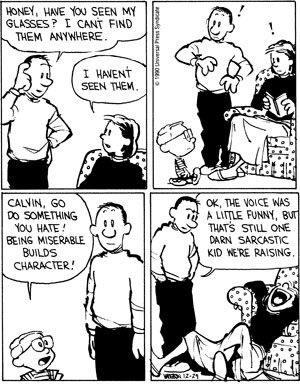
In other words, while my main parenting tool is cuddles, I have some of Calvin’s Dad in me (from “Calvin and Hobbes”) who always insisted that doing hard things builds character.
When it started raining harder, R was borderline crying. I started running next to her while telling her she’s brave and strong and capable. After a while she started arguing with me. “No, I can’t ride a bicycle as well as boys! I can’t do this anymore!” Unfortunately, by that stage there was no alternative. We had to keep pushing on to get back to the car. So I kept running next to R but instead of coming up with a somewhat intelligent speech I turned her semi-cry into a full-on scream, the excited kind. It seemed to work to an extent, at least R started pedalling much harder to keep up with me until we were out of the park and on to the footpath – a final stretch to the car.
I found uplifting speeches and books that teach behaviour completely ineffective as R’s parent (the twins are somewhat different). In movies a well formulated monologue always seems to help at least a little. R was always skeptical. And she could always feel an agenda in a book a mile off (when I tried to wean her and read her books about weaning she learned to hide the books very quickly). But running next to her and screaming into the void seemed to be effective.
Just when we thought we were in the clear, it started pouring down. “Go fast R”, I said without trying to teach anything anymore. “Go to the car as fast as you can, I’m right behind you.” By then we were both soaked and I gave up trying to avoid puddles as my socks and shoes were completely drenched. R got into the car and I loaded the bike in.
“I want to take off my pants, they are so wet,” R said.
“Don’t you want to go to Woolies? I’ll buy you any lollies you want”.
So we got lollies and a yoghurt for each of us, then R took off her soaked jeans off and I drove home. By then the rain completely stopped.
At home, we sneaked upstairs for a hot bath. When we were finished, the bath was covered in mud.
“Well that was an adventure,” I said.
“Yeah, I even liked the start of it,” R said.
We went downstairs where I told James and the twins how brave and strong and capable R was while she plopped on the couch to watch cartoons.
I started driving fairly late in life, and learning to drive will be forever entangled with the early years of immigration for me. The theory was easy but the practical skill of driving turned out not to be. It’s hard to separate my own lack of confidence and skill from the culture shock I was feeling, and the ever present shadow of a dysfunctional relationship with the boyfriend who taught me to drive.
After I got my license (and eventually broke up with the boyfriend) I drove quite a bit for a while. But the moment I didn’t have to, I stopped. It was never quite relaxing. I always preferred to walk if I could. We bought better cars for our growing family. Riley, our first, was a fireball of a baby in many ways, and she hated the car. I attempted taking her to a few places by myself and ended up on the verge of tears as she worked herself up into a screaming mess of pure distress and anger. After a few times I almost completely gave up driving, even by myself. I still haven’t driven our car with all three children in it.
These days my life is very different from those early years in Australia when I was learning to drive and tried desperately to fit in, it’s better in almost every possible way. I’ve got a family who keeps me grounded even when I feel like I’m losing my mind. I have deep friendships. Better job. Better job prospects. And today, probably for the first time in my life, I realised that driving to a shop well and truly felt easier than walking even though it’s not a long walk. There was no struggle in my head over it. No “everyone is doing it so you should be too!”, no “don’t be a chicken and just do it”, no “oh well I know I can do it and I will”. Just getting into a car, driving there, parking, getting the ice cream and driving back.
It truly felt like amazing progress, even after over 10 years of driving.
For most people in Australia it probably is nothing. They might have not moved to another country by themselves with no money to speak of or rebuilt their life from scratch by themselves; they might have not mastered another language or got two degrees or had twins; but driving – that’s a given for most people, more natural than walking in many cases. But it is significant for me.
These days Riley loves being in a car and we go to the beach together. We got a second car so I could drop her off at school (she’s starting “big school” in a week!) and she enjoys the simple little car even more than our big fancy car with reverse camera and leather seats. In some ways, so do I.
It’s the little things that strike me sometimes when I look at my past achievements. Being able to make small talk and joke around in English. Being comfortable with phone conversations and meeting new people (a double bummer for introverts who speak a second language). Hopping into a car and just driving wherever you need to go. We concentrate so much on bigger things: our relationships, our jobs, our bank balance but the little things can be such a struggle precisely because it’s something that is seemingly effortless for everyone else but you. I might strike another little thing off my list now and that’s a great start to a new year.
A few years ago when I was sailing a lot, sometimes up to 4 harbour races a week and offshore ones when possible, I used to get very specific tan lines on my hands. My hands looked white apart from the tips of my thumbs, perfectly matching my sailing gloves. We called it the Mickey Mouse tan.
The other day I looked at my hands and I realised there was a tan pattern on them now, too, a totally different one: fingers white up to the second phalanges then tanned evenly. It took me a moment to realise that the tan lines are caused by my pushing a pram every day, sometimes more than once a day. What a great metaphor of how my life changed, I thought. I used to be a very involved sailor and now I am a mother.
Some people, including my own mother, expressed astonishment at the fact that I am now a mother of three (granted, I was as surprised as anyone when we discovered that instead of leaping from one to two we skipped a step and jumped straight to three; nobody plans for twins). Some thought I was too interested in other, non maternal things like my career (or sailing), others no doubt remembered how much I struggled adjusting to having just one child. Yet the astonishment stings a bit too, as I probably invested more in being a great mother to my first than in anything else in my life and I never had any doubt I’d do my best with more than one, too.
Having three has been chaos. The twins are two months old and have already copped a few daycare colds brought home by Riley. A congested newborn is not a happy baby. I’ve listened to my oldest child cry for me in the middle of the night as I was pinned down by a feeding pillow with two newborns on it; my child who was never left to cry, used to reliably being comforted by me, was scared in the middle of the night in her own bed alone in her room and I wasn’t able to help. Sometimes all three cry at the same time. Sometimes I join in the crying, too.
I feel like I need to write about the upside of having multiple kids at this point of my blog post. How blessed we are to have three healthy kids (despite the copious amounts of snot in every single nose in this house right now), how sweet the babies are and how cute and funny Riley is. How James turned into a great father who is confidently taking all three kids out by himself while I try to catch up on at least some sleep. Mostly though we are surviving. We keep reminding ourselves not to wish time away and maybe one day I will miss this season when I am so desperately needed by all my children but right now I just keep saying to myself that the hardest days will pass and we’ll have the reward of children who learn how to play and share with others (I am sure I will regret these words in the future), who will always have each other even when they are adults. I’m reminding myself that our Christmas will be far more magical for having multiple kids, that I will be able to watch each of them grow into their own person which is my favourite part of parenting. And then I catch myself awash with the same astonishment I find so hurtful in others: how could it be that I am a mother of three?
Some people climb mountains, going all the way to the top where they are oxygen starved, freezing and in constant danger of dying where nobody will be able to retrieve their bodies. Some do long offshore races, soaked to the bone, fighting off nausea and tethered to the sides of the boat trying not to fall out. By far more people have multiple children and while some seem to breeze through that experience, a lot of us struggle with round the clock care duties, sleep deprivation and the constant terror of doing something wrong and scarring a person fully dependent on us for life. It’s not considered special by society because it’s so common yet as a way to find meaning bringing up kids can be more relentless than an offshore sailing race, more intimidating than climbing a mountain peak. We can’t turn back and so we continue on our way, clutching on to every tiny pleasure along the way. With time the relentlessness of it somewhat eases, our kids need us a bit less until they seemingly don’t need us at all – and then we’ll have to reinvent ourselves again. Who knows what my tan line is going to be then.
I can’t say I ever fully planned my life and so far what worked for me was doing my best with what I’ve got and letting things happen. And as I look into two brand new little faces all I can do is hope everything will turn out great for them, too.
My husband is doing the Sydney to Hobart race this year and I really hope he makes it to Hobart this time. We have two unfinished Hobarts between the two of us. Mine was interrupted by a rudder bearing when we barely made it out of the habour. James’s boat made it half way there before a decision was made to abandon the race for numerous reasons including a ripped mainsail. We probably owe our entire relationship to my failed Hobart as we hadn’t talked much before it, and sailing is something we will always have in common.
Except this year I did very little sailing (mostly twilights) and he got an opportunity to get on a boat that’s going to Hobart. I am excited for him, and the decision not to sail much was entirely mine, yet sometimes I feel acutely that something’s missing in my life and I ache for it, all of it: the sea, the sails, the friendly banter on board, the scramble during gybes, even the tiredness after the race. The club and the beer. Admittedly, I miss offshore sailing much less than harbour races; I would even say I don’t miss it at all except for an occasional twitch of regret which goes away as I remind myself of seasickness, the cold at night, the seemingly never ending hours of staring at spinnakers.
James serviced my PFD for his own use and bought a new PLB. He got some new wet weather gear. All his offshore stuff is scattered all over the floor of our daughter’s bedroom and when I tell her that Daddy went sailing she just assumes he must be fishing, too, which is an activity she really enjoys.
Meanwhile, I got several reminders that my Sea Safety and Survival certification expired so I’d have to do it again if I decided to go back to offshore sailing. And somehow it seems even further from me than the first year when Riley was a newborn and I was trying to figure out how to survive day by day with a tiny (and often unsettled) baby.
Yet I don’t really have any regrets. Yes, I miss sailing, more than other things I don’t really do any more (such as staying out late or going away by myself for too long or even getting drunk) but it’s also the right thing for me to do right now.
This year has been tough in many ways. Early in the year I found out I am slowly going blind in one eye. Riley broke her leg. And not that long ago I had a miscarriage, something almost nobody talks about as if it’s something shameful even though it’s pretty common and completely out of control of the woman who goes through it.
And right now our beautiful state of NSW is on fire. We are in severe drought which makes fires so much worse, and the smoke is so bad it makes air toxic when Sydney is covered with it. The air quality in Sydney has never been as bad as it was this week – they even had to cancel the Big Boat Race due to lack of visibility in the harbour.
Yet when I think of the year that’s almost gone I also think how everyday life has been beautiful and enjoyable in a lot of ways. I did a lot of thinking and reading, some relationships developed further, I feel more comfortable in my own skin at work. But most of all, I think of Riley, how funny she is now, how much we talk, of simple things but also some more complex things, how we play “tunnel” while “shoo fly” is on repeat. And I think of my husband who constantly forgets why he went to the kitchen and loses his wallet but who’s also been most caring, easy-going, supportive man. And I laugh because after spending a lot of time on self improvement, study and work I found myself agreeing with all those annoying people who say that having kids is the most challenging but also the most rewarding thing you can do with your life but also because it’s easy to step away from something you love when you find something that you love even more.
“Reef the main!” – Joris shouted. I got to the halyard while he leaped to the other side to the reef lines. The main sail started coming down, flapping wildly in the wind.
“Stop!” – yelled Marco. “The slug! The slug is out!”
I looked at the main. The middle part of it was out of the track. We were screwed. Did it just show 35 knots on the wind instrument? The rain was belting down so hard, it felt like hail. Or was it actual hail? It hung in the air like a semi-transparent blanket so we could barely see the land in front of us and some boats a few metres away. We were all totally drenched, not a single offshore jacket between us.
“Let’s drop the main,” – said Greg and started the motor.
“It’s not coming down unless I climb the mast!” – said Marco.
It was a Friday twilight, another relaxed social race after a long work week. Only this time it turned out to be slightly less relaxed than normal.
It started off as a beautiful sunny afternoon but as I was getting on the boat at the club we were staring at the horizon. “Some interesting cloud formations over there,” someone said as another lightning struck. It was clear we’d get soaked at some point of the race but none of us minded that much.
The race committee (or rather our old mate Dave, the manager) chose the shortest course, and it was shortened even further after we started. It was dramatic enough for us from the start. A shorter course means that the division with biggest and fastest boats that starts last quickly converges with previous divisions. In the limited space between islands of the West Harbour it turns into dodge’em cars. Our troubles started even earlier though. As we were beating up to the top mark in a very fresh breeze, a boat above us seemed to bear down on us despite our yells.
“Watch your rig!” – our skipper yelled as their mast leaned further and further towards ours.
As we lost height, we got close to the mark and it turned out we had no room with two boats on top of us. There was nothing to do but bear away and do a 360. The two boats above us seemed to keep yelling at each other. We were now well behind everyone.
It started raining soon after and hush fell over the water. No wind. We adjusted sails and moved crew weight around and we crept forward. Then the storm hit us.
Nobody panicked. We had experienced crew that night and people knew what to do. It felt surreal to experience this kind of weather at a twilight but I caught myself grinning ear to ear. We sailed normally for a while, water collecting on the main and landing on my head on top of the torrential rain. Then we got even more wind and heeled more and more, it became clear we had to reduce our sail area – hence the call to reef the main.
We did manage to get both sails down somehow, radioed the club and motored back. I looked at the blisters on my hands and thought of nothing but sailing. The raging flood of thoughts and helplessness that didn’t let me sleep the night before and gnawed at me all hours of the day that week, was gone. I looked at Chris’s 20 year old daughter who was a guest on the boat that night and smiled at her.
“That was scary! I thought we were going to capsize” – she said in her English accent. As I explained to her that capsizing a sailing yacht is not that easy, I kept thinking that I wasn’t planning to do much on the boat that night as we had plenty of experienced people but ended up doing my regular job anyway with no debate from anyone. What a difference from when I first got on that boat all those years ago when it was a privilege to be a sewer rat who helped getting the spinnaker down through the hatch. How I fretted that I lost all my muscle strength, all my trimming knowledge while on maternity leave. None of it mattered that much in the end.
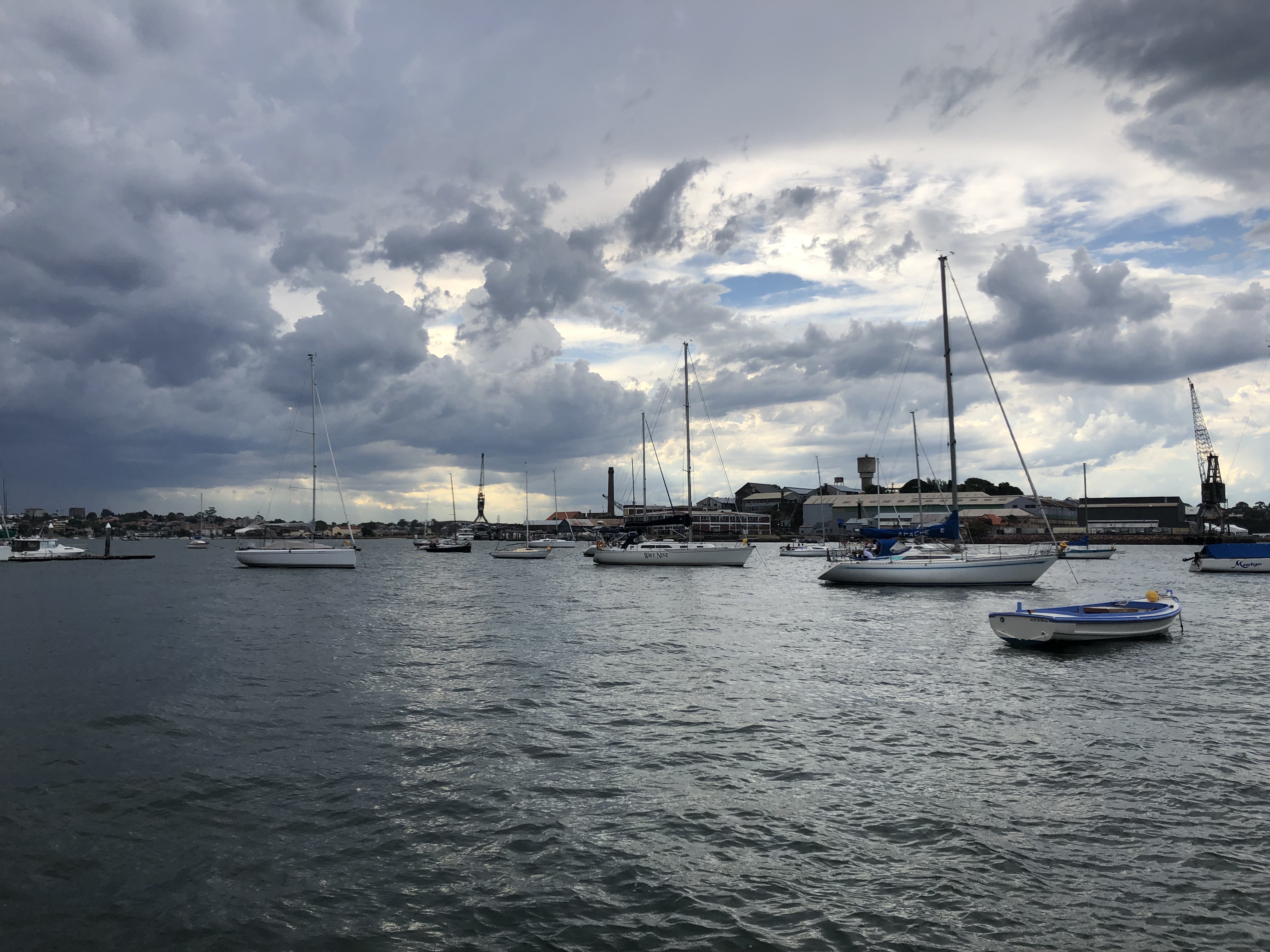
I did my first twilight race for the first time in almost 3 years. The club – probably the friendliest sailing club in Sydney, the place where I started sailing – has changed a little: there’s more open space and the facilities are much improved. There are still a lot of familiar faces around. Some have new boats. The boat that I used to own lost a mast a few months ago and still requires a lot of work. The main thing is that the place has the same wonderful welcoming atmosphere. It’s still very easy to get on a boat. There is always someone to chat to. The food is simple but satisfying and so are the drinks.
I was on a boat I used to sail a lot on (and helmed on a Lady’s day race once). When I messaged the skipper, I wasn’t sure what I would be allowed to do during the race, seeing that I haven’t sailed for a while and the boat has always been quite competitive. Turned out that there were a couple of experienced people on the boat, a bunch of complete novices and a French guy who claimed that he knew how to sail but could not understand any of the instructions in English so I ended up doing most of the headsail trim and strings.
Breeze is always temperamental in Balmain. It bends around islands and changes speed and directions in ways that make it tricky to predict what’s going to happen next sometimes. The forecast was for 20 knots yet it died completely towards the end of the race (that’s when the entire fleet caught up with us as we were sitting in a hole).
I loved it all. The unpredictable wind, the feeling that I know exactly what I was doing, using my muscles, joking around, having a beer on a downwind leg (it’s thirsty work!), chatting after the race. The breeze itself. That my foot got wet. That I was asked to do the rest of the season and then asked to crew on a dinghy again.
It’s easy to see the appeal of twilight sailing – it’s social, mostly relaxed (although not without its own dramas) and it’s great to be on the water on a nice summer day. Sunsets are spectacular. All in all, it’s a perfect way to wind down after a week at work. For me it was also a gateway drug to more serious sailing that requires more skill and commitment and longer offshore races with their sleep deprivation, seasickness, lack of showers, risks of serious trauma or (if you’re very careless or/and unlucky) even death. When trying to explain the appeal of offshore racing (which could be very similar to explaining the appeal of climbing icy mountains – “because it’s there!”), I could only mutter something about the sense of accomplishment after you’ve finished the race while in reality I was mostly craving more of what I was getting at every single twilight: the feeling of mastery of a complicated skill, letting go of everything but the race, breeze on my face and the feeling of belonging right here and now, on this boat and with this crew. It’s unlikely I’ll be doing offshore racing any time soon (life is too busy!) so it’s great comfort to know that twilight sailing is still here for me. And it’s still magical.






 Sails and Commas