Tossing things aside

I played a few games of cornhole at a work event this week. I am usually pretty terrible at any casual games like bowling or mini-golf, mostly because I never practise them outside work events. So imagine my surprise when I won a game. Then another one. A lovely American from work then saw it as a challenge and eventually obliterated me but it was fine, I was mostly surprised I did so well to begin with.

Then I realised why – a few years back I was trying to get Riley to play something active and somehow we ended up throwing a little ball into a laundry basket. At the beginning of the game we stood right next to the basket and whenever one of us got the ball into the basket, we would move further away. A super casual game that requires zero prep. We still play it from time to time, except now the twins participate too. I never really cared about winning or getting better at the game, mostly about keeping the kids happy and engaged. We play it every few months max. And yet, somehow it helped to train my throw enough that I can win an unanticipated game of cornhole.

That’s a huge contrast to my usual approach to things: I tend to dive into things. At some point I was sailing 3-4 times a week, offshore racing, reading books about trimming sails. When I started strength training, I was learning the basics with a coach then started reading books about it and advice online; with time I added mobility exercises and some skill work. Even though I often struggle to find time to exercise I definitely give it a lot of headspace: always looking how to improve, to do everything better. And then there are things I really care about, like work and children and their education. And sometimes I wonder if giving all of those things so much consideration and space in my thoughts helps – or just makes me exhausted. Maybe if I just cared a little less or at least let things go when I am not actively involved in doing them, I would be less tired.

There are caveats of course – tossing a bag or a ball requires far less skill or consideration than helping a child get better at writing. And yet it’s such an enticing idea that we can sometimes get better at things just by casually doing them every now and again, without thinking about it at all. In the world that keeps telling us that the most important thing to achieve things in life is discipline it’s pretty counterintuitive to just… do things occasionally, for fun, without planning. I’d like to think of a more lighthearted, more fun version of myself.

Approaching life that way would require lowering the stakes though. Can I care about work less when it’s not just about my ego and to a certain extent my identity but also about paying off a mortgage and taking care of my family? Can I care less about my children’s emotional health and their education? It doesn’t seem possible – so I don’t seem to be able to toss them out of my head the way I forget about a game of cornhole. And yet, when I do have a little time, I will try to remind myself then I can also let go of some things and tread lightly, with no obligation to achieve any results whatsoever. Now how do I not overthink this whole not-overthinking thing…

Numbness and being alive

What do you do when you struggle to find enjoyment in anything? When every day feels like a never ending stream of chores to be followed by another day of chores, with responsibilities and other people’s expectations shaping up your every day?

I tend to numb myself when not working: listening to audiobooks, cleaning, ticking off other chores, staring at social media, not allowing myself to pause to avoid being overwhelmed by wondering why is this life that I built for myself – in fact worked very hard to build – can feel so miserable, like there is no space for myself in it. But that numbness only makes it worse, I feel like I disappear into nothing and lose all sense of myself as a person, my inner light completely lost as I retreat, dull eyed, after a moment of joy with one of the girls. I sleep dreaming of being abandoned over and over or being stuck in a place I cannot leave – that’s my brain’s revenge for not giving it any breathing space to chew on that question.

This happens to me from time to time, especially when the weather is miserable and I don’t have enough sleep. I remember a couple of years ago I took a single day off work to revel in reading, having a slow, lazy lunch and walking along the beach. Three hours into it I got a call that one of the twins was sick and that I had to go home and look after her. That feeling of utter defeat – I don’t know how you avoid it. No matter how many times you tell yourself to be grateful (and I am truly grateful for so many things in my life), not having any control of your life for even one day can be soul crushing.

I do eventually snap out of that feeling of being completely depleted. One morning I wake up and feel warmth in myself; I don’t rush to look at my phone, I suddenly feel enjoyment in my cup of tea, my comfortable seat on the couch. I start writing again. Suddenly, I don’t just notice the cuteness of my girls in an abstract, remote way, I notice how they react to me as I tickle them and breathe in their smells. I see warmth in my husband’s eyes. I return to myself and wonder how I can treasure my little humans so much but never seem to apply the same love and acceptance to myself. But I can never arrive at that moment by sheer willpower. You can understand certain things intellectually and yet it does not help you to feel better at all.

Where does that numbness, that grim feeling of overwhelm comes from to begin with? It’s tempting to blame it all on the stress of modern lives, with ridiculous property prices and expectations of being able to work as if we don’t have kids and parent as if we don’t have jobs. I know for me it’s much more than that, it’s the perpetual feeling of being unseen when I lose connection with the outside world and myself.

I am fortunate enough to have friends who I connect with on a deeper level, despite all of us having hectic, overwhelming lives. We might not see each other often but being able to be completely open with each other is priceless. I remember talking to a friend while eating chilli crab in Singapore. We hadn’t seen each other for several years, she moved countries, we both had more children and many other changes and some setbacks in life – and yet we felt so close in that conversation, no need to guard ourselves from being misinterpreted and misunderstood.

That’s not going to happen with every single person in our lives, I understand it intellectually; yet I try sometimes and then that openness makes me vulnerable. Being open turns into exposing weakness to someone who will not reciprocate. I cringe at how uncool it is to try to be friends who is always guarded against you.

Yet the best things in my life came from risk – risk of leaping into unknown and risk of opening up instead of keeping up appearances. I shudder to think what my life would be like if I contorted myself into a cooler version of myself who pretends to always be in control, who isolates different parts of her life completely. That version would be much less me – and I want to be more me and stop losing the sense of myself when I am overwhelmed and doubt everything. Eventually I find my own way back to myself – that’s when enjoyment creeps slowly back into my life, even when there is still way too much to do.

The Road Not Taken

I was watching surfers last night. We had epic surf on Good Friday to the point there was practically no beach left at Avoca where we are spending the long weekend. It settled a bit on Saturday, waves came in clear sets and there was an occasional gleam of green in contrast to the day before when the wave tops were immediately blown off to churn white all the way to the beach. Surfers were everywhere. They get so close to the rocks it seems way too dangerous. Then one of them pops up on a wave and takes off, down the wave then up and no matter how many times I see it, I never get tired of it and it never stops being, well, magic. Witchery.

I grew up in Siberia and apart from doing ballet as a 6 year old, cross country skiing in the forest across the road from our apartment block and mandatory PE in school, I was not an athletic child. I wore glasses and I always had a book to read, long before it was known that distracting yourself from the world around you is unhealthy (but I was doing it with books not devices so I guess it was ok). And yet when I first got access to satellite TV I was mesmerised by the channel that was showing skateboarding and surfing. The persistence and skill required to do those things seemed way cooler than anything that I could do (a sad poem, anyone?). If I could transport my conscience into someone else’s body for an hour I’d choose an experienced surfer on a good surfing day, for the experience of that high of mastery over your own body and the ocean that can so easily kill you.

I did try surfing after I moved to Australia. It was way before I got into sailing and I took many lessons with a community college and got to know a few people, mostly surfing instructors. I lacked the upper body strength but my balance was fine. I had tremendous fun even in white water and I did manage to catch a few waves, mostly with the instructor’s help. It was pretty clear though that I’d have to basically live on the beach and practice every day, not once a week if I wanted to get serious about it. I would also need to either keep paying an instructor or somehow find someone who’d be ok to at least go surfing with me which seemed impossible with all the other things happening in my life.

I haven’t surfed in ages.

It’s interesting to think what could have been though if I made different choices in life and surfing is one of them. And if I was born in Australia to someone who sent me to nippers, would I be a completely different person, ripping down and up the waves, would that be something so natural and easy for me that I’d take it for granted? What would that life feel like? Somehow I am convinced I’d still find a way to be anxious and questioning my choices. There would be different worries (my friend circle? Source of income? A very vague feeling that I could’ve learned to write better? Maybe they wouldn’t be all that different after all) but I doubt I’d escape unscathed. It is a fun exercise to indulge in right before your birthday though, considering all the lives you could’ve had.

Life with three kids can be intense and sometimes James and I joke about what our lives could be like if we remained childfree (lots of spare cash, probably a seaside apartment instead of a house, much travel and delicious food and should I mention loads of uninterrupted sleep) but ultimately we both agree that it would’ve come with a sense of loss even if we didn’t exactly know what that loss was about. I’m sure there are people who don’t long for children but I struggle to imagine being one of them. It’s one of those choices in life I can’t imagine not making and it seems inevitable, just like moving from my hometown to St Petersburg and then to Australia, maybe because I imagine the kind of regret I’d have had very clearly.

And then there are choices in life that seem a bit less clear cut. Choosing one job over another (I nearly went to Ireland instead of Australia). Choosing sailing over surfing. Ending or continuing a friendship. While some of them seem more important than the other, do we really know which ones are true bifurcation points?

I am still fairly sure I’d arrive at some version of me that might be physically slightly different but fundamentally the same. Somehow I cannot imagine a version of me who doesn’t overthink or who is more confident than sensitive. I’d probably be tortured by different things. I might fight joy in different things, too. Yet it appears to me that through any circumstances my own self would inevitably crystallise and if all those versions of me ever met they would all enjoy a conversation about what it means to be me, just like I’m enjoying writing this post right now.

Then again, it wouldn’t be me if I didn’t add that I could be completely wrong about all of it.

Enchantment, enshittification and our future

Many years ago, when Google already existed but wasn’t a verb yet, I wrote a research paper for uni about online media. I wish I had that paper and especially the sources I used (academic articles in English that I translated into Russian). Unfortunately, they are all long gone but I do remember the gist of them surprisingly well.

Two particular ideas are stuck in my memory: 1. How texts (will) change when published online. 2. The influence of gatekeepers on how information is filtered and spread online.

There was a lot of speculation back then about how articles posted online would transform due to the differences of online media. Hyperlinks would change texts, they would enrich each other and present new demands on the reader’s attention. Imagine a network of articles, creating a three dimensional narrative through linked texts, possibly written by various authors. How different would it be from a traditional book or a magazine, both in execution and perception. What a wonderful new world.

If you ever get lost on TVTropes.org, you might taste a little of that vision. Overall though, that prediction now seems like a dream of someone completely removed from the realities of human’s attention and perception. What actually happened is that – in general – texts became shorter, headlines are manipulated to produce maximum outrage, people are attacking each other in the comments over the headline not the article (and those are not just Daily Mail’s readers). Texts disappear overnight to be replaced by something new and seemingly everyone is bemoaning our inability to read longer texts. Navigating through a maze of hyperlinks is the least of our issues these days.

Then again, Substack seems to be doing alright, even if it’s not quite a garden of links creating a united complex narrative.  

The idea of gatekeepers who determine which information we consume back then was attached to Internet directories, something incredibly common before search became more reliable, and personal blogs – influencers, in other words even if that word didn’t exist back then. Overall it wasn’t a prediction that feels completely wrong now: we do, after all, have social media that makes it possible for a piece of content to go viral. There are groups of people who reinforce their convictions through posting links to content that confirms their beliefs. And while it’s rare in the West for access to information online to be restricted (apart from paywalls), it turns out people often just don’t want to read or watch something that contradicts what they are already thinking. It once again feels like the reality of what we are seeing today – the abundance of misinformation and attempts to control the narrative – is not so much interesting as depressing.

I wonder what the authors of those papers could be thinking now? Did they shake their heads at their early works about online media, wondering at their naiveté? Or did they gradually changed their opinions and completely forgot that there was an age when the Internet seemed like a blessing, when all of us were enchanted by it and it wasn’t all so complicated?

Although of course it’s not complicated at all to a lot of people now either – it’s just that if the Internet and technology in general used to be seen as majorly good, it is now seen as predominantly evil. According to many people, it’s the technology that is destroying democracy and our ability to pay attention and think critically.

There’s another article that I read ages ago and to my delight it still exists online – here. When I re-read it now, 13 years later, I am struck by the optimism of it as the author discusses economic impact of free content and new economic models related to it. How different it is from the view of today, of “enshittification” which is tightly tied to monetisation and economic growth at all costs.

I do miss the sense of enchantment with technology and with life in general. It might be that my own social circle is different now; I work in tech and it’s far less of a happy place now that interest rates went up and money became expensive. I am tired of listening to stories of doom and gloom though; I find that it’s not hard to be pessimistic. It’s easy to predict that the Internet will die or become useless due to abundance of AI slop. It’s also a low hanging fruit these days to write about everything that is wrong with technology and how our attachment to mobile devices destroys our attention span and our will to live and connect with other people.

What I take comfort in is that most predictions don’t seem to come true, even when – and maybe especially – when they seem obvious. The general mood of the era seem to affect the predictions more than anything else and right now we seem to be in an era of profound pessimism. We take it for granted that it’s easy to do a lot of things now, like pay bills or buy a book, to the point that we start doubting that it’s actually good for us – but I don’t think that it’s the technology that makes things easier for us that is the problem. It’s what we do our time that we could be spending in a queue to pay a bill. It’s up to us how we use the technology. We have agency. And the future is still up in the air and not known by anyone.

Oh to be seen

I stumbled upon “Fleabag” by accident last year, late to the party, and I was stunned by how good it was. How had I not heard of it before? It’s expertly written and acted; it’s tragic, subtle and incredibly funny. If you haven’t seen it, I recommend you do (make sure there are no children around you if you do. It would probably be very awkward to watch it with your parents, too).

The unnamed main character has a habit of breaking the fourth wall, looking directly at the camera and telling us her thoughts. It works very well in the context of the show but clearly nobody does that in real life. What I personally do instead is I pretend to write it down in my head as if someone is going to read it. It’s the same idea of an invisible friend who would be interested in everything that happens to us, every smart arse comment, every semi-formed insight we might have. A friend who does not actually exist.

And yet in season 2 Fleabag meets a person who really sees her – a priest. He sees how she disappears into her thoughts and he tries to understand her.

Phoebe Waller-Bridge, the creator of Fleabag, has a speech about why the priest has become known as “hot priest” and why a lot of women seems to have lost their minds longing after him. “It’s because he does this one thing… he listens.” It’s funny and pithy and there’s undoubtedly truth to it, even if there’s inevitably more to it than that: he’s handsome, funny, not afraid to be vulnerable, he’s unavailable as a partner. And yet.

If you ever struggled with small talk (like I used to) and consciously tried to become better at conversations in general, you would’ve inevitably come across advice to listen to other people and to be genuinely interested in them. Almost everyone loves talking about themselves and people will love you for listening. In the context of small talk most people won’t go very deep and it’s a bit weird to be that person who goes “But really, tell me how you REALLY feel”. Trust builds over time and so does intimacy, not of the sexual kind but of the kind that allows you to talk about something deeper than how you spent your weekend. I do like trying to nudge people along a little while not coming across as a total creep. It makes for a much more interesting conversation but also I am genuinely interested in many people and the stories in their heads. It’s not just listening – it’s trying to understand.

Do all people want to be understood? Not just on a surface level but on a level where they most likely don’t even understand ourselves? I think a lot of the time they – we – don’t. It makes us feel vulnerable, especially when we are not ready for it. Fleabag in the show cannot bring herself to open up to the priest about her friend – too painful – and she tell us, the audience, when he tries to understand, “He’s a bit annoying, actually”. I’ve been the annoying friend before and it’s painful to be shut down, too, so people often don’t even try to ask the questions that can be interpreted as prying.

And yet, when it works, it’s like magic. And when it’s reciprocal – which is even more rare – there’s nothing like it. People sometimes avoid it because it feels dangerous, inappropriate (even if it doesn’t end up in forbidden Catholic priest sex). More often though, we just don’t know if it’s even an option, to be understood on a deep level – and accepted for who we are. Not for our social roles or appearances but as complex human beings with our inhibitions and fears and contradictory thoughts. I think we sometimes crave it without realising what it is we want. That desire is easy to mock; it sounds like vapid teenager angst, “Nobody really understands me!” But I think the raw desire for intimacy and understanding expressed in that statement is much better than many layers of self protection we learn to wear every day.

Being a Sneaky Sasquatch

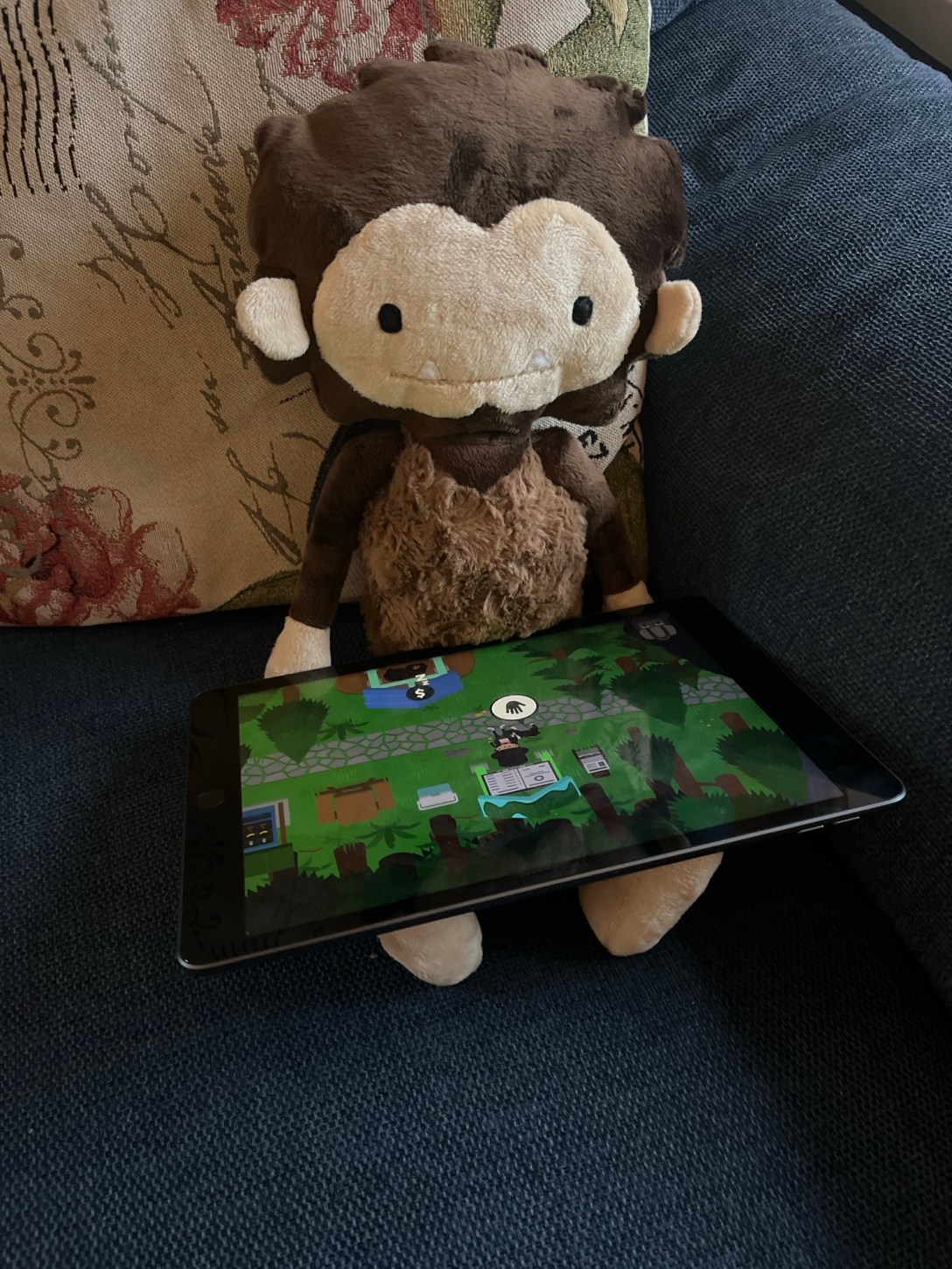
We started playing Sneaky Sasquatch about 3 years ago when R was 5. It’s one of the top games on Apple Arcade, it’s regularly updated and doesn’t have ads or microtransactions.

It starts as a very simple game, with Sasquatch (a yeti-like creature) living in a national park. He needs to steal food without attracting attention of the campers and especially the rangers. He can gradually make a little money by looking for treasure and selling stolen food to a bear. Once he gets some clothes, a fishing rod and a golf club, he can make more money while exploring the campground and beyond. Eventually, he saves the campground from a greedy capitalist (twice), finds the source of pollution in the lake and becomes a mayor. There is a ridiculous amount of side quests (including setting up sources of passive income) and it’s completely unnecessary to complete the main storyline or any of the quests to enjoy the game.

We finished the main storyline twice and did a lot of side quests. We didn’t play for a while but these days R is able to finish most of the storylines by herself – as long as I help her with the money part of the story.

Perhaps my favourite part of the game is that you need to feed Sasquatch every single day. A day in his universe is much shorter than in ours so that means you need to constantly hustle to get food. Even if you do have a reliable source on income, it does not make getting food that much easier – you still need to either buy it or steal it, whether in the shops, at a cafe or somewhere else. You can also get a dog in the game (it’s a multi-step quest that R was able to finish by herself) and you need to feed the dog too – and it refuses inappropriate food like grapes and anything containing chocolate.

Needless to say, R and both twins who now also expressed interest in the game struggle with that task. If any of them asks me for any kind of help, the first thing I check is whether they fed Sasquatch (and the dog). He also needs to go to sleep every night.

Funnily enough, that’s also the first rule for humans – if you are grumpy or depressed, ask yourself, are you sure you fed yourself and slept enough? Works with children too, if they are being completely unreasonable, are you sure they ate and slept enough?

At least Sasquatch doesn’t get progressively grumpier if he hasn’t eaten or slept. He does eventually faint if you don’t feed him or don’t let him sleep when he’s sleepy and you are penalised: the animals bring him home but charge you some coins. With the girls’ track record of looking after him I am also positive that they are not ready for any kind of pet that requires regular care (we do occasionally look after our neighbour’s dog but as much as the children beg to see him, they don’t worry about feeding him).

Sasquatch can acquire many skills in the game: there are different types of fish and mushrooms to collect, some very rare. There are dinosaur bones to find with the help of the dog. You can race cars, boats, go-karts, dirt bikes. You can play golf, ski and surf. You can work in the port loading and unloading ships with a crane and a forklift and doing night security. As part of a mission you also work in an office (starting in the mail room) and become a police officer (who fines drivers breaking rules). For some of these activities you need licenses. Most of them earn you money. There is a clear progression. Some of them require a genuine skill, like surfing which is not mandatory for any of the missions but makes travelling to the island much easier and can earn easy income if you know what you’re doing. That’s the part of the game I find most addictive and my children have no interest in.

I swear I spent hours getting Sasquatch to become a better surfer. I am not proud of it and yes, instead I should’ve been spending that time reading Proust to my children or making them organic food out of unicorn tears but in my defence I did it in tiny increments like 10 or 15 minutes at a time that somehow added up to hours of gameplay. First, you need to understand the principle of getting maximum points. You can also upgrade the surfboard as long as you keep winning while competing with various surfers on the island. But eventually, you just need to grind (practice again and again) to become better.

I found it incredibly addictive – instant feedback, some randomness and the clear progression as you improve at this skill which is completely optional in the game, let alone in the actual outside world. When I eventually won the hardest surfing battle I felt a real sense of achievement. I know that all three of my children have some respect for me because I can surf really well in Sneaky Sasquatch. That’s three people – probably slightly more than the number of people who regularly read this blog. Don’t tell me it’s not a real accomplishment! On the other hand, if your read this far you now know why there will never be a video console in this house and the only games I allow myself to play are on an iPad.

You would think acquiring skills like that would be addictive to my children, too, but that’s not the case. Even R who is now older and is capable of finishing missions by herself (she worked her way up from a mailroom boy to an executive in one of the missions) has no interest in practising this obscure skill again and again to get better at it. She asks me to do it to get some quick cash. Funnily enough, when we resumed playing after an almost 3 year break I found that my surfing in Sasquatch is better than ever! I can easily get to record numbers now. And yet I can barely remember any Japanese I learned before the twins were born. That seems unfair.

On the other hand, what I hate is driving any car in the game long distances which is required for some missions. And yet R doesn’t mind it at all. She would cheerfully drive back and forth delivering lumber to her house as long as it allows her to build it up a bit more. In fact, her favourite part of the game when she was younger was customising Sasquatch’s house, outfits and – later, when Sasquatch became a mayor – the town. I would spend hours grinding the surfing skills and she would spend it all on a pimped out car which would say “CAT” on the bonnet, make all the buildings in the town purple and rename the apartment blocks into a Hospital (by the way, there is a hospital in the game and she did that entire side quest by herself after which she decided that when she grows up she is definitely NOT going to be a doctor).

In other words, as I was busy making money and building skills, she was enjoying life to the max. Kind of like in real life. Now, 3 years later, she suddenly realised she needs to make money and stops her little sisters from spending it. You learn budgeting in more ways than choosing a toy under $10 in the shops, I guess (a side quest I never had when I was a child growing up in Siberia).

Now, these days W (age 4) tells me she wants to be a firefighter when she grows up. She’s the smallest of our children and most fond of princess dresses and her own blonde curls. At first I didn’t realise where that dream came from, suspecting childcare, but then I looked at her playing Sasquatch and I realised she picked it up there. It’s true what they say, video games affect children in truly unexpected ways – they might eventually learn to feed their pets every day, save money, play golf with other executives and even decide to become a firefighter instead of a doctor. Beware.

P.S. R had a very short stint playing Roblox which very quickly turned her eyes glassy so that game is banned in our house.

Wavewalker

A combination of holidays, my parents’ visit and conversations with an old friend launched my year in a best possible way: I started consistently reading and finishing books again. I’ve never really stopped reading completely but in recent years I started switching between books too much, often taking too long to finish them and abandoning the ones that required too much effort or attention. Magically, when I slowed down and stopped rushing and switching between tasks I discovered mental clarity that I haven’t felt in years, with word practically jumping out of the page at me. Amazing what focussing on just reading and resting can do for you, even when you still have three relatively young children.

One of the first books I read in January was “Wavewalker” which I picked randomly out of my queue. It’s an autobiographical book written by a woman who spent 10 years of her childhood on a boat and hated it. Sailing is a subject close to my heart but I was fully prepared for the book not to focus much on the actual sailing (judging by the excerpt ) and I wasn’t disappointed. The book is much more about parental neglect and the author’s trauma than anything else, even if the author does not use those specific words. The sentiment and the presented facts are clear: while the initial plan was to follow Captain Cook’s route for 3 years, the family ended up cruising for 10, often in extremely unfavourable conditions which made it impossible to cook and led to a fairly severe physical injury in Suzy. The parents also completely neglected their children’s education, expected Suzy (but not her brother) to assist with all domestic chores on the boat, did not give the children any input into their future and eventually abandoned them in New Zealand for months with very minimal money and support. The mother who suffered from seasickness and fits of bad temper picked fights with paying crew and her own daughter. Despite the lack of support, Suzanne managed to eventually get accepted into Oxford.

The parallels with another memoir, “Educated” by Tara Westover, are pretty clear, even if “Educated” is more celebrated (and better written). Both girls possessed an incredible drive to learn and study, they both eventually defied their environment and changed their own lives against overwhelming odds. Tara’s family in “Educated” is radical Mormon; Suzy’s parents mock anything related to religion. Suzy’s Dad identifies himself as a benevolent dictator and he is mostly that; Tara’s father most likely has a serious mental illness. While there’s clear abuse in “Educated”, “Wavewalker” is much more about neglect. And yet, both Tara and Suzy ultimately struggle to control anything in their own lives and they both gravitate towards self-education. They both strive to belong yet cannot live in the suffocating environment. And while for Tara that environment is often contained in a literal junk yard, Suzy’s backdrop is often beautiful yet still feels oppressive to her.

It seems that the author of “Wavewalker” didn’t quite make sense of her childhood, she asks some painful questions about her parents who saw her upbringing as privileged – a view she clearly doesn’t share – yet doesn’t have any answers. It is a big contrast with “Educated” that presents a much more nuanced, complex view and often incorporates the author’s later insights about her family and the events she’s describing.

There doesn’t seem to be any reflection in the book on how parents often define the circumstances of their children’s lives, even if it’s usually less dramatic than a 10 year ocean cruising adventure. The author is a widow and has children, she has been successful in business – surely she herself ran against some of her children’s wishes. While most of us do not cruise the ocean with our children, the parents still define where the entire family live, which schools the children go to, what they eat and wear. We put them in childcare when they might not want to go. We work too much and miss their performances and we go on business trips instead of reading with them. A “benevolent dictator” is something that is often touted as a parental ideal, even if it’s used in a different context to the one Suzy’s father had. If the children were well fed, treated with some affection and educated during the family’s adventure, would it still be unacceptable to live on the boat because children were sick of it and wanted a stable life? Did the author ever struggle with balancing her ambition and bringing up her children later in life? I wish the author reflected on it with the benefit of her own experience as a child. Is it even acceptable to have children if the only thing that makes you happy is an adventure that might make them miserable? And is there a reliable way to make sure they don’t write a condemning book about you when they grow up (I guess not being interesting enough is a good start)?

You won’t find any attempts to answer those questions in the book. The narrative suggests that Suzy might have had attachment issues due to her parents’ neglect, her relationship with her brother seem surface-level despite the years of shared misery. There is almost nothing there about her own children. I think that’s a missed opportunity but maybe she’s just leaving a chance for them to write their own book.

Annual Reflections

Last year as I was writing my reflections on the year that just went past, I felt totally exhausted, morally and physically. You can probably read it between the lines in the post. As I was planning to write this post (and I’ve been meaning to do it for at least two weeks), I was thinking that this year I have been in a much better place mentally but it’s probably the present moment that feels more manageable, not the whole year.

It was a year of ups and downs. I changed jobs again, joining yet another tech company, I went to Vegas for the company kick-off then to Singapore for onboarding, doing more travel and time away from home that I’ve had in a while. I was reluctant to go and yet both trips rejuvenated me despite the jet lag and packed schedules. It felts like I rediscovered myself again outside my role as a mother. I was drunk on all the conversations I had with new and familiar people and my whole self felt suddenly much more interesting and deep than I’ve felt for a very long time. Then an inevitable hangover happened as I had to readjust back to the life where nothing really is about me or my needs, it’s all about the children and wider family, the customers and management at work.

I’ve grappled with questions about my own identity for a while. To some extent it seems like an inevitable part of becoming a parent and adjusting to the change in lifestyle (it’s only been 8 years). I am also an immigrant (speaking with an accent), an introvert (who needs time alone to feel normal), I enjoy reading some difficult texts (who I have no one to discuss with). I tend to dwell on things and struggle to stop when too much thinking ceases to bring any new insights and becomes a pointless and disquieting loop in my head. I’ve always longed to do something out of the ordinary, something to lift me up from the everyday existence, not because I don’t like or appreciate that existence but because that elevation lights me up inside. I sometimes feel truly alive while researching a topic or while writing. I chased the same high while sailing. Sometimes I feel it as I spend time with my children. It’s a combination of awe and being truly present in the world. And while there is some time and space for chasing that feeling even when you have several children and a full time job, it definitely shrinks to the point you have to be extremely determined to still chase that feeling while doing something on top of your responsibilities and I’m afraid I might not have that determination. Where does it leave me? Who am I as a person?

What I realised this year though is that concentrating too much on myself does not help answer that question. In fact, thinking and talking too much about myself leaves me with an emotional hangover. I read a book about chatter after hearing about it on my favourite podcast then read another book after hearing about it on the same podcast and that was extremely helpful to quieten the restless voice in my head. I am not sure I answered the question of who I am but I’ve learned to focus on other things instead.

The children have been flourishing this year – they play with each other much more and it doesn’t always end in tears although they still require an intervention at times, not of a parental referee but a guide who helps resolve arguments without physical force. I. continues to be the most athletic of our girls, easily balancing on her bike and starting to swim without any swimming lessons (the twins are starting their swimming lessons next year, thanks to their grandparents). R. made some progress in gymnastics, made a great friend at school, started going to a dancing class with her friend and had her first dancing concert – it was a great performance which left me strangely emotional. She started riding her bike this year, tying her shoelaces, getting more into maths. She still struggles with writing and I have been deep diving into different approaches to education trying to help her.

W. has much more patience than the other two for listening to books, drawing and doing other quiet activities – finally a stereotypical girl, the only one out of our three. She loves being a little princess and the contrast between her and I., her twin sister who is a total tomboy, is sometimes comical.

This year I probably went to the gym a bit less than I wanted to, not just because of the usual winter sicknesses and commitments but also from fatigue. I tried other approaches to physical activity, too – got into mobility work and explored some combinations of gymnastics and calisthenics. I still feel the best when I regularly go to the gym and do strength training.

We are planning to buy our own place if everything goes well.

What I am hoping for in the new year is payoff for some of the things that I’ve been doing for years now, at work and in personal life. I still don’t feel like I’m getting enough sleep. I still wish I played the piano more, painted more, wrote more. I want to read with the girls more, learn more new things. And I think if I do more of these things I will be more myself, too.

Why so serious?

R has been going to gymnastics for over a year. She goes to a fairly small club that emphasises fun over competition which is probably the healthiest approach to children’s sport. Yet we almost didn’t rejoin this term, and the main reason was that I didn’t see much improvement in what R was doing. She also often lost interest by the end of the class and instead of practicing she’d do absolute minimum and make faces at me, in her usual monkey manner.

I talked to a few parents while sitting on the bench waiting for R to finish her classes. One girl who used to be friendly with R dropped out after Christmas because her Mum didn’t see results (and it was inconvenient for the whole family to do sports on Saturday morning). A couple of people I knew from my previous jobs brought their kids – and then I didn’t see them anymore. Both of the parents echoed my secret desire to see their kids doing perfect cartwheels and flips when we chatted. I am not sure what happened after – all I know I don’t see them at gymnastics anymore.

In the end, I was talked into continuing by another mother whose daughter has been doing gymnastics with R for a while. I look forward to talking to her every Saturday and that was probably the biggest reason why I signed R up again. That, and R actually telling me she enjoys gymnastics.

By the middle of the term R’s cartwheels suddenly improved. She now pays attention at the end of class. And come to think of it, she’s generally far less clumsy than she used to be.

Somehow she still mostly just enjoys the class, sometimes getting things right, sometimes not. I can imagine myself if I was somehow transported into a child’s body without losing the tendencies of my own age and experience – I would try to get the most value out of each class, do everything just right, constantly increase complexity and compete with myself. In other words, I would probably take all the fun out of it. I’d take it too seriously and get frustrated. I’m pretty stubborn so I as that imaginary child would probably not quit – but I probably wouldn’t get any joy out of it either, too focussed on results.

Needless to say, when I was an actual child I did not have that mindset. I did quit ballet after two years and I didn’t finish music school. The approach towards children education both in sport and in music back in Russia had nothing to do with fun and recreation – you were expected to work hard to get results. And I know that a lot of my enjoyment of music was lost in my childhood because learning music was all hard work and very little fun. Only now, many years later, I allowed myself to play the piano very casually, occasionally, for my own enjoyment – although I suspect if I didn’t have the excuse of having three children, a full time job and too many hobbies, I’d probably start trying to get more serious about improvisations and all the other skills that were not covered in my childhood education, possibly getting to the place when playing the piano is not enjoyable once again.

Yet R who can be pretty resistant to any kind of pressure somehow, almost by magic, managed to acquire skills just by sticking to weekly lessons and not taking them too seriously. Yes, it took a long time – a very long time by the standards of our impatient times. But the big plus is, she’s still enjoying it, too.

I had a dream that my children would do nippers (train to be lifesavers) – who wouldn’t enjoy running around on the beach, training to be safe in the ocean? R, that’s who. She started just before she turned 5 and she hated it then and the next term when we tried again. She hated being last while running, she hated how sand hit her bare legs when it was windy, she was clingy and miserable and so we quit. And a voice in my head told me for years and years that R didn’t enjoy anything all that much and maybe it was worth persisting despite her wishes. I know that voice is not really an enemy, it’s the same voice that urged me to practice reading and writing with R and researching the best ways to learn spelling and maths. Yet in the end what often works best with R is just giving her time and agency to decide how she engages with whatever she’s doing.

And as it often happens in parenting, I am not sure who learns more in all this – the child who acquires a skill of doing cartwheels and writing complex sentences, or the parent who learns to let go sometimes and trust the process and their child. I know I am currently trying to apply whatever I learned in my own life: hold my desires very lightly and don’t take them too seriously, invest time in following my interests and slowly build skills without fixating on it. Maybe one day I’ll be able to do a cartwheel too.

Riding in the rain

It was supposed to rain all day yesterday but it cleared up in the afternoon. On Saturdays we have fish and chips for lunch then I walk around the lake talking to my mother on the phone. Lately I started including R in these walks – she rides her bike while I run along (sometimes) or walk behind (more often). She decided to come with me yesterday too.

Since it rained a lot in the morning, the parking lot was nearly empty. We were off to a good start. R didn’t want to wear her rain coat despite the stiff breeze so I was carrying it myself. I knew it would be muddy in parts of the track but didn’t have the heart to tell R that her pretty new cardigan, t-shirt and her jeans would probably get mud on them once she blitzed over a few puddles. She rode off past one playground, the water sports shed then another playground and I smiled thinking how much more confident on her bike she got over the last few months.

I called Mum and we were chatting about the weather in Siberia (hot) and our updates for the week. All that time R was far ahead, stopping from time to time to let me catch up. Finally, we got to a muddier area.

“Too many puddles,” R said when I walked up to her.

“You can do it, just go faster,” I said, interrupting my conversation with my Mum, then pushed R a little to help her over a puddle.

R grumbled and groaned but went over a few muddy tracks. I kept talking to my mother until it became clear that R needed a better motivational speech than I was providing. I said good bye to Mum then turned my full attention to R. She was by then moaning that she’s not enjoying riding the bike through the mud. The back of her cardigan was now speckled with mud.

We bought the bike more than two years ago and R rode it a handful of times with training wheels. At the end of last year I decided that it wasn’t right that R still couldn’t ride it without training wheels – she had no problems on her balance bike when she was three but we spent less and less time walking around after having twins. We’d drive to a playground and there would be no time or space for R’s bike. I was hoping my parents who were visiting for Christmas holidays would take R out and teach her but after one or two times my Dad admitted defeat – he had no desire to run after a kid’s bike, even if the kid in question was his beloved granddaughter. Understandable when you’re almost 70. So one day I decided that James and I would both go to the park with R without the twins and make sure she learns. The night before she cried to me that she would never learn to ride it without training wheels. On the day she sat on the bike, started pedalling and ever since then the training wheels were a thing of the past.

I wanted R to enjoy her bike. Part of it is my own great memories of riding a bike everywhere. My bike was heavy (and was technically my sister’s) and the first time I rode it by myself I went over some dried up mud, fell down and sliced my leg open with a sharp part – I still have a scar to show for it. It didn’t deter me. I rode with a friend who lived nearby and by myself a lot. I was a little older than R and when I wasn’t reading I was riding the bike everywhere. I wanted R to have at least some of that experience even if I can’t imagine letting her go off by herself.

It started drizzling and R’s complaints intensified. I helped her put the raincoat on but her bell bottom jeans were wet and muddy up to her knees. I kept telling R that it was an adventure while considering putting my own raincoat on.

Then it started raining a bit harder.

You’d think we’d turn around but by then going back would’ve taken longer than pushing ahead – besides, I didn’t want to turn back. I wanted R to push through the mud and the rain and find if not pleasure then satisfaction in that ride. Something I felt many times while sitting on the rail of a sailing boat in the rain; dreaming of hot tea and bagels yet somehow also finding something compelling in that experience. Perhaps people climbing mountains while experiencing lack of oxygen feel it to a larger extent. While I don’t expect R to seek out uncomfortable experiences, I do want her to go through some to gain more confidence.

In other words, while my main parenting tool is cuddles, I have some of Calvin’s Dad in me (from “Calvin and Hobbes”) who always insisted that doing hard things builds character.

When it started raining harder, R was borderline crying. I started running next to her while telling her she’s brave and strong and capable. After a while she started arguing with me. “No, I can’t ride a bicycle as well as boys! I can’t do this anymore!” Unfortunately, by that stage there was no alternative. We had to keep pushing on to get back to the car. So I kept running next to R but instead of coming up with a somewhat intelligent speech I turned her semi-cry into a full-on scream, the excited kind. It seemed to work to an extent, at least R started pedalling much harder to keep up with me until we were out of the park and on to the footpath – a final stretch to the car.

I found uplifting speeches and books that teach behaviour completely ineffective as R’s parent (the twins are somewhat different). In movies a well formulated monologue always seems to help at least a little. R was always skeptical. And she could always feel an agenda in a book a mile off (when I tried to wean her and read her books about weaning she learned to hide the books very quickly). But running next to her and screaming into the void seemed to be effective.

Just when we thought we were in the clear, it started pouring down. “Go fast R”, I said without trying to teach anything anymore. “Go to the car as fast as you can, I’m right behind you.” By then we were both soaked and I gave up trying to avoid puddles as my socks and shoes were completely drenched. R got into the car and I loaded the bike in.

“I want to take off my pants, they are so wet,” R said.

“Don’t you want to go to Woolies? I’ll buy you any lollies you want”.

So we got lollies and a yoghurt for each of us, then R took off her soaked jeans off and I drove home. By then the rain completely stopped.

At home, we sneaked upstairs for a hot bath. When we were finished, the bath was covered in mud.

“Well that was an adventure,” I said.

“Yeah, I even liked the start of it,” R said.

We went downstairs where I told James and the twins how brave and strong and capable R was while she plopped on the couch to watch cartoons.