Enchantment, enshittification and our future

Many years ago, when Google already existed but wasn’t a verb yet, I wrote a research paper for uni about online media. I wish I had that paper and especially the sources I used (academic articles in English that I translated into Russian). Unfortunately, they are all long gone but I do remember the gist of them surprisingly well.

Two particular ideas are stuck in my memory: 1. How texts (will) change when published online. 2. The influence of gatekeepers on how information is filtered and spread online.

There was a lot of speculation back then about how articles posted online would transform due to the differences of online media. Hyperlinks would change texts, they would enrich each other and present new demands on the reader’s attention. Imagine a network of articles, creating a three dimensional narrative through linked texts, possibly written by various authors. How different would it be from a traditional book or a magazine, both in execution and perception. What a wonderful new world.

If you ever get lost on TVTropes.org, you might taste a little of that vision. Overall though, that prediction now seems like a dream of someone completely removed from the realities of human’s attention and perception. What actually happened is that – in general – texts became shorter, headlines are manipulated to produce maximum outrage, people are attacking each other in the comments over the headline not the article (and those are not just Daily Mail’s readers). Texts disappear overnight to be replaced by something new and seemingly everyone is bemoaning our inability to read longer texts. Navigating through a maze of hyperlinks is the least of our issues these days.

Then again, Substack seems to be doing alright, even if it’s not quite a garden of links creating a united complex narrative.  

The idea of gatekeepers who determine which information we consume back then was attached to Internet directories, something incredibly common before search became more reliable, and personal blogs – influencers, in other words even if that word didn’t exist back then. Overall it wasn’t a prediction that feels completely wrong now: we do, after all, have social media that makes it possible for a piece of content to go viral. There are groups of people who reinforce their convictions through posting links to content that confirms their beliefs. And while it’s rare in the West for access to information online to be restricted (apart from paywalls), it turns out people often just don’t want to read or watch something that contradicts what they are already thinking. It once again feels like the reality of what we are seeing today – the abundance of misinformation and attempts to control the narrative – is not so much interesting as depressing.

I wonder what the authors of those papers could be thinking now? Did they shake their heads at their early works about online media, wondering at their naiveté? Or did they gradually changed their opinions and completely forgot that there was an age when the Internet seemed like a blessing, when all of us were enchanted by it and it wasn’t all so complicated?

Although of course it’s not complicated at all to a lot of people now either – it’s just that if the Internet and technology in general used to be seen as majorly good, it is now seen as predominantly evil. According to many people, it’s the technology that is destroying democracy and our ability to pay attention and think critically.

There’s another article that I read ages ago and to my delight it still exists online – here. When I re-read it now, 13 years later, I am struck by the optimism of it as the author discusses economic impact of free content and new economic models related to it. How different it is from the view of today, of “enshittification” which is tightly tied to monetisation and economic growth at all costs.

I do miss the sense of enchantment with technology and with life in general. It might be that my own social circle is different now; I work in tech and it’s far less of a happy place now that interest rates went up and money became expensive. I am tired of listening to stories of doom and gloom though; I find that it’s not hard to be pessimistic. It’s easy to predict that the Internet will die or become useless due to abundance of AI slop. It’s also a low hanging fruit these days to write about everything that is wrong with technology and how our attachment to mobile devices destroys our attention span and our will to live and connect with other people.

What I take comfort in is that most predictions don’t seem to come true, even when – and maybe especially – when they seem obvious. The general mood of the era seem to affect the predictions more than anything else and right now we seem to be in an era of profound pessimism. We take it for granted that it’s easy to do a lot of things now, like pay bills or buy a book, to the point that we start doubting that it’s actually good for us – but I don’t think that it’s the technology that makes things easier for us that is the problem. It’s what we do our time that we could be spending in a queue to pay a bill. It’s up to us how we use the technology. We have agency. And the future is still up in the air and not known by anyone.

Oh to be seen

I stumbled upon “Fleabag” by accident last year, late to the party, and I was stunned by how good it was. How had I not heard of it before? It’s expertly written and acted; it’s tragic, subtle and incredibly funny. If you haven’t seen it, I recommend you do (make sure there are no children around you if you do. It would probably be very awkward to watch it with your parents, too).

The unnamed main character has a habit of breaking the fourth wall, looking directly at the camera and telling us her thoughts. It works very well in the context of the show but clearly nobody does that in real life. What I personally do instead is I pretend to write it down in my head as if someone is going to read it. It’s the same idea of an invisible friend who would be interested in everything that happens to us, every smart arse comment, every semi-formed insight we might have. A friend who does not actually exist.

And yet in season 2 Fleabag meets a person who really sees her – a priest. He sees how she disappears into her thoughts and he tries to understand her.

Phoebe Waller-Bridge, the creator of Fleabag, has a speech about why the priest has become known as “hot priest” and why a lot of women seems to have lost their minds longing after him. “It’s because he does this one thing… he listens.” It’s funny and pithy and there’s undoubtedly truth to it, even if there’s inevitably more to it than that: he’s handsome, funny, not afraid to be vulnerable, he’s unavailable as a partner. And yet.

If you ever struggled with small talk (like I used to) and consciously tried to become better at conversations in general, you would’ve inevitably come across advice to listen to other people and to be genuinely interested in them. Almost everyone loves talking about themselves and people will love you for listening. In the context of small talk most people won’t go very deep and it’s a bit weird to be that person who goes “But really, tell me how you REALLY feel”. Trust builds over time and so does intimacy, not of the sexual kind but of the kind that allows you to talk about something deeper than how you spent your weekend. I do like trying to nudge people along a little while not coming across as a total creep. It makes for a much more interesting conversation but also I am genuinely interested in many people and the stories in their heads. It’s not just listening – it’s trying to understand.

Do all people want to be understood? Not just on a surface level but on a level where they most likely don’t even understand ourselves? I think a lot of the time they – we – don’t. It makes us feel vulnerable, especially when we are not ready for it. Fleabag in the show cannot bring herself to open up to the priest about her friend – too painful – and she tell us, the audience, when he tries to understand, “He’s a bit annoying, actually”. I’ve been the annoying friend before and it’s painful to be shut down, too, so people often don’t even try to ask the questions that can be interpreted as prying.

And yet, when it works, it’s like magic. And when it’s reciprocal – which is even more rare – there’s nothing like it. People sometimes avoid it because it feels dangerous, inappropriate (even if it doesn’t end up in forbidden Catholic priest sex). More often though, we just don’t know if it’s even an option, to be understood on a deep level – and accepted for who we are. Not for our social roles or appearances but as complex human beings with our inhibitions and fears and contradictory thoughts. I think we sometimes crave it without realising what it is we want. That desire is easy to mock; it sounds like vapid teenager angst, “Nobody really understands me!” But I think the raw desire for intimacy and understanding expressed in that statement is much better than many layers of self protection we learn to wear every day.

Being a Sneaky Sasquatch

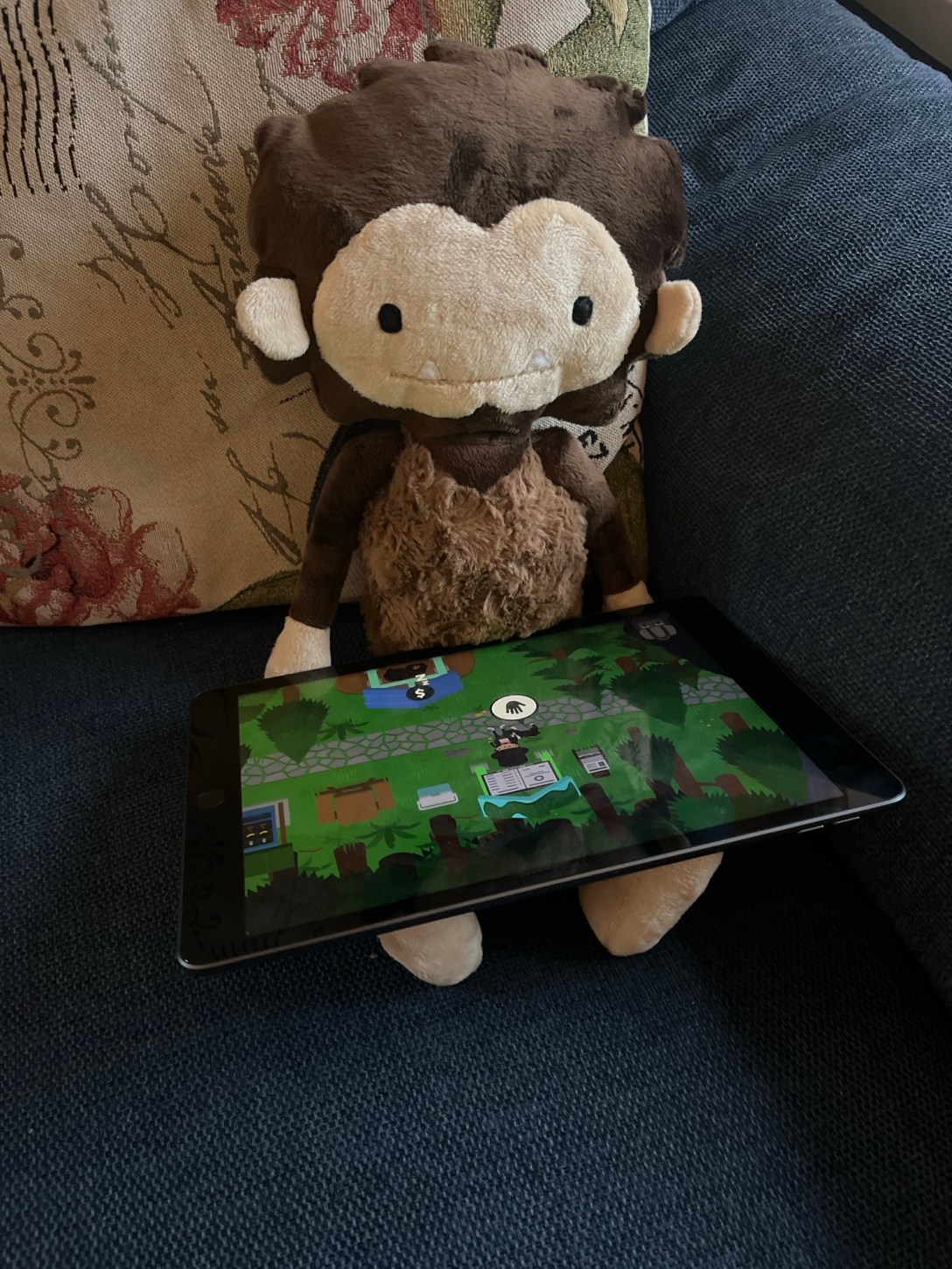
We started playing Sneaky Sasquatch about 3 years ago when R was 5. It’s one of the top games on Apple Arcade, it’s regularly updated and doesn’t have ads or microtransactions.

It starts as a very simple game, with Sasquatch (a yeti-like creature) living in a national park. He needs to steal food without attracting attention of the campers and especially the rangers. He can gradually make a little money by looking for treasure and selling stolen food to a bear. Once he gets some clothes, a fishing rod and a golf club, he can make more money while exploring the campground and beyond. Eventually, he saves the campground from a greedy capitalist (twice), finds the source of pollution in the lake and becomes a mayor. There is a ridiculous amount of side quests (including setting up sources of passive income) and it’s completely unnecessary to complete the main storyline or any of the quests to enjoy the game.

We finished the main storyline twice and did a lot of side quests. We didn’t play for a while but these days R is able to finish most of the storylines by herself – as long as I help her with the money part of the story.

Perhaps my favourite part of the game is that you need to feed Sasquatch every single day. A day in his universe is much shorter than in ours so that means you need to constantly hustle to get food. Even if you do have a reliable source on income, it does not make getting food that much easier – you still need to either buy it or steal it, whether in the shops, at a cafe or somewhere else. You can also get a dog in the game (it’s a multi-step quest that R was able to finish by herself) and you need to feed the dog too – and it refuses inappropriate food like grapes and anything containing chocolate.

Needless to say, R and both twins who now also expressed interest in the game struggle with that task. If any of them asks me for any kind of help, the first thing I check is whether they fed Sasquatch (and the dog). He also needs to go to sleep every night.

Funnily enough, that’s also the first rule for humans – if you are grumpy or depressed, ask yourself, are you sure you fed yourself and slept enough? Works with children too, if they are being completely unreasonable, are you sure they ate and slept enough?

At least Sasquatch doesn’t get progressively grumpier if he hasn’t eaten or slept. He does eventually faint if you don’t feed him or don’t let him sleep when he’s sleepy and you are penalised: the animals bring him home but charge you some coins. With the girls’ track record of looking after him I am also positive that they are not ready for any kind of pet that requires regular care (we do occasionally look after our neighbour’s dog but as much as the children beg to see him, they don’t worry about feeding him).

Sasquatch can acquire many skills in the game: there are different types of fish and mushrooms to collect, some very rare. There are dinosaur bones to find with the help of the dog. You can race cars, boats, go-karts, dirt bikes. You can play golf, ski and surf. You can work in the port loading and unloading ships with a crane and a forklift and doing night security. As part of a mission you also work in an office (starting in the mail room) and become a police officer (who fines drivers breaking rules). For some of these activities you need licenses. Most of them earn you money. There is a clear progression. Some of them require a genuine skill, like surfing which is not mandatory for any of the missions but makes travelling to the island much easier and can earn easy income if you know what you’re doing. That’s the part of the game I find most addictive and my children have no interest in.

I swear I spent hours getting Sasquatch to become a better surfer. I am not proud of it and yes, instead I should’ve been spending that time reading Proust to my children or making them organic food out of unicorn tears but in my defence I did it in tiny increments like 10 or 15 minutes at a time that somehow added up to hours of gameplay. First, you need to understand the principle of getting maximum points. You can also upgrade the surfboard as long as you keep winning while competing with various surfers on the island. But eventually, you just need to grind (practice again and again) to become better.

I found it incredibly addictive – instant feedback, some randomness and the clear progression as you improve at this skill which is completely optional in the game, let alone in the actual outside world. When I eventually won the hardest surfing battle I felt a real sense of achievement. I know that all three of my children have some respect for me because I can surf really well in Sneaky Sasquatch. That’s three people – probably slightly more than the number of people who regularly read this blog. Don’t tell me it’s not a real accomplishment! On the other hand, if your read this far you now know why there will never be a video console in this house and the only games I allow myself to play are on an iPad.

You would think acquiring skills like that would be addictive to my children, too, but that’s not the case. Even R who is now older and is capable of finishing missions by herself (she worked her way up from a mailroom boy to an executive in one of the missions) has no interest in practising this obscure skill again and again to get better at it. She asks me to do it to get some quick cash. Funnily enough, when we resumed playing after an almost 3 year break I found that my surfing in Sasquatch is better than ever! I can easily get to record numbers now. And yet I can barely remember any Japanese I learned before the twins were born. That seems unfair.

On the other hand, what I hate is driving any car in the game long distances which is required for some missions. And yet R doesn’t mind it at all. She would cheerfully drive back and forth delivering lumber to her house as long as it allows her to build it up a bit more. In fact, her favourite part of the game when she was younger was customising Sasquatch’s house, outfits and – later, when Sasquatch became a mayor – the town. I would spend hours grinding the surfing skills and she would spend it all on a pimped out car which would say “CAT” on the bonnet, make all the buildings in the town purple and rename the apartment blocks into a Hospital (by the way, there is a hospital in the game and she did that entire side quest by herself after which she decided that when she grows up she is definitely NOT going to be a doctor).

In other words, as I was busy making money and building skills, she was enjoying life to the max. Kind of like in real life. Now, 3 years later, she suddenly realised she needs to make money and stops her little sisters from spending it. You learn budgeting in more ways than choosing a toy under $10 in the shops, I guess (a side quest I never had when I was a child growing up in Siberia).

Now, these days W (age 4) tells me she wants to be a firefighter when she grows up. She’s the smallest of our children and most fond of princess dresses and her own blonde curls. At first I didn’t realise where that dream came from, suspecting childcare, but then I looked at her playing Sasquatch and I realised she picked it up there. It’s true what they say, video games affect children in truly unexpected ways – they might eventually learn to feed their pets every day, save money, play golf with other executives and even decide to become a firefighter instead of a doctor. Beware.

P.S. R had a very short stint playing Roblox which very quickly turned her eyes glassy so that game is banned in our house.