Why so serious?

R has been going to gymnastics for over a year. She goes to a fairly small club that emphasises fun over competition which is probably the healthiest approach to children’s sport. Yet we almost didn’t rejoin this term, and the main reason was that I didn’t see much improvement in what R was doing. She also often lost interest by the end of the class and instead of practicing she’d do absolute minimum and make faces at me, in her usual monkey manner.

I talked to a few parents while sitting on the bench waiting for R to finish her classes. One girl who used to be friendly with R dropped out after Christmas because her Mum didn’t see results (and it was inconvenient for the whole family to do sports on Saturday morning). A couple of people I knew from my previous jobs brought their kids – and then I didn’t see them anymore. Both of the parents echoed my secret desire to see their kids doing perfect cartwheels and flips when we chatted. I am not sure what happened after – all I know I don’t see them at gymnastics anymore.

In the end, I was talked into continuing by another mother whose daughter has been doing gymnastics with R for a while. I look forward to talking to her every Saturday and that was probably the biggest reason why I signed R up again. That, and R actually telling me she enjoys gymnastics.

By the middle of the term R’s cartwheels suddenly improved. She now pays attention at the end of class. And come to think of it, she’s generally far less clumsy than she used to be.

Somehow she still mostly just enjoys the class, sometimes getting things right, sometimes not. I can imagine myself if I was somehow transported into a child’s body without losing the tendencies of my own age and experience – I would try to get the most value out of each class, do everything just right, constantly increase complexity and compete with myself. In other words, I would probably take all the fun out of it. I’d take it too seriously and get frustrated. I’m pretty stubborn so I as that imaginary child would probably not quit – but I probably wouldn’t get any joy out of it either, too focussed on results.

Needless to say, when I was an actual child I did not have that mindset. I did quit ballet after two years and I didn’t finish music school. The approach towards children education both in sport and in music back in Russia had nothing to do with fun and recreation – you were expected to work hard to get results. And I know that a lot of my enjoyment of music was lost in my childhood because learning music was all hard work and very little fun. Only now, many years later, I allowed myself to play the piano very casually, occasionally, for my own enjoyment – although I suspect if I didn’t have the excuse of having three children, a full time job and too many hobbies, I’d probably start trying to get more serious about improvisations and all the other skills that were not covered in my childhood education, possibly getting to the place when playing the piano is not enjoyable once again.

Yet R who can be pretty resistant to any kind of pressure somehow, almost by magic, managed to acquire skills just by sticking to weekly lessons and not taking them too seriously. Yes, it took a long time – a very long time by the standards of our impatient times. But the big plus is, she’s still enjoying it, too.

I had a dream that my children would do nippers (train to be lifesavers) – who wouldn’t enjoy running around on the beach, training to be safe in the ocean? R, that’s who. She started just before she turned 5 and she hated it then and the next term when we tried again. She hated being last while running, she hated how sand hit her bare legs when it was windy, she was clingy and miserable and so we quit. And a voice in my head told me for years and years that R didn’t enjoy anything all that much and maybe it was worth persisting despite her wishes. I know that voice is not really an enemy, it’s the same voice that urged me to practice reading and writing with R and researching the best ways to learn spelling and maths. Yet in the end what often works best with R is just giving her time and agency to decide how she engages with whatever she’s doing.

And as it often happens in parenting, I am not sure who learns more in all this – the child who acquires a skill of doing cartwheels and writing complex sentences, or the parent who learns to let go sometimes and trust the process and their child. I know I am currently trying to apply whatever I learned in my own life: hold my desires very lightly and don’t take them too seriously, invest time in following my interests and slowly build skills without fixating on it. Maybe one day I’ll be able to do a cartwheel too.

Riding in the rain

It was supposed to rain all day yesterday but it cleared up in the afternoon. On Saturdays we have fish and chips for lunch then I walk around the lake talking to my mother on the phone. Lately I started including R in these walks – she rides her bike while I run along (sometimes) or walk behind (more often). She decided to come with me yesterday too.

Since it rained a lot in the morning, the parking lot was nearly empty. We were off to a good start. R didn’t want to wear her rain coat despite the stiff breeze so I was carrying it myself. I knew it would be muddy in parts of the track but didn’t have the heart to tell R that her pretty new cardigan, t-shirt and her jeans would probably get mud on them once she blitzed over a few puddles. She rode off past one playground, the water sports shed then another playground and I smiled thinking how much more confident on her bike she got over the last few months.

I called Mum and we were chatting about the weather in Siberia (hot) and our updates for the week. All that time R was far ahead, stopping from time to time to let me catch up. Finally, we got to a muddier area.

“Too many puddles,” R said when I walked up to her.

“You can do it, just go faster,” I said, interrupting my conversation with my Mum, then pushed R a little to help her over a puddle.

R grumbled and groaned but went over a few muddy tracks. I kept talking to my mother until it became clear that R needed a better motivational speech than I was providing. I said good bye to Mum then turned my full attention to R. She was by then moaning that she’s not enjoying riding the bike through the mud. The back of her cardigan was now speckled with mud.

We bought the bike more than two years ago and R rode it a handful of times with training wheels. At the end of last year I decided that it wasn’t right that R still couldn’t ride it without training wheels – she had no problems on her balance bike when she was three but we spent less and less time walking around after having twins. We’d drive to a playground and there would be no time or space for R’s bike. I was hoping my parents who were visiting for Christmas holidays would take R out and teach her but after one or two times my Dad admitted defeat – he had no desire to run after a kid’s bike, even if the kid in question was his beloved granddaughter. Understandable when you’re almost 70. So one day I decided that James and I would both go to the park with R without the twins and make sure she learns. The night before she cried to me that she would never learn to ride it without training wheels. On the day she sat on the bike, started pedalling and ever since then the training wheels were a thing of the past.

I wanted R to enjoy her bike. Part of it is my own great memories of riding a bike everywhere. My bike was heavy (and was technically my sister’s) and the first time I rode it by myself I went over some dried up mud, fell down and sliced my leg open with a sharp part – I still have a scar to show for it. It didn’t deter me. I rode with a friend who lived nearby and by myself a lot. I was a little older than R and when I wasn’t reading I was riding the bike everywhere. I wanted R to have at least some of that experience even if I can’t imagine letting her go off by herself.

It started drizzling and R’s complaints intensified. I helped her put the raincoat on but her bell bottom jeans were wet and muddy up to her knees. I kept telling R that it was an adventure while considering putting my own raincoat on.

Then it started raining a bit harder.

You’d think we’d turn around but by then going back would’ve taken longer than pushing ahead – besides, I didn’t want to turn back. I wanted R to push through the mud and the rain and find if not pleasure then satisfaction in that ride. Something I felt many times while sitting on the rail of a sailing boat in the rain; dreaming of hot tea and bagels yet somehow also finding something compelling in that experience. Perhaps people climbing mountains while experiencing lack of oxygen feel it to a larger extent. While I don’t expect R to seek out uncomfortable experiences, I do want her to go through some to gain more confidence.

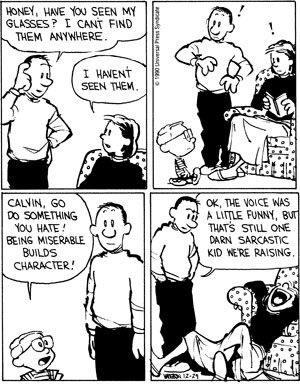
In other words, while my main parenting tool is cuddles, I have some of Calvin’s Dad in me (from “Calvin and Hobbes”) who always insisted that doing hard things builds character.

When it started raining harder, R was borderline crying. I started running next to her while telling her she’s brave and strong and capable. After a while she started arguing with me. “No, I can’t ride a bicycle as well as boys! I can’t do this anymore!” Unfortunately, by that stage there was no alternative. We had to keep pushing on to get back to the car. So I kept running next to R but instead of coming up with a somewhat intelligent speech I turned her semi-cry into a full-on scream, the excited kind. It seemed to work to an extent, at least R started pedalling much harder to keep up with me until we were out of the park and on to the footpath – a final stretch to the car.

I found uplifting speeches and books that teach behaviour completely ineffective as R’s parent (the twins are somewhat different). In movies a well formulated monologue always seems to help at least a little. R was always skeptical. And she could always feel an agenda in a book a mile off (when I tried to wean her and read her books about weaning she learned to hide the books very quickly). But running next to her and screaming into the void seemed to be effective.

Just when we thought we were in the clear, it started pouring down. “Go fast R”, I said without trying to teach anything anymore. “Go to the car as fast as you can, I’m right behind you.” By then we were both soaked and I gave up trying to avoid puddles as my socks and shoes were completely drenched. R got into the car and I loaded the bike in.

“I want to take off my pants, they are so wet,” R said.

“Don’t you want to go to Woolies? I’ll buy you any lollies you want”.

So we got lollies and a yoghurt for each of us, then R took off her soaked jeans off and I drove home. By then the rain completely stopped.

At home, we sneaked upstairs for a hot bath. When we were finished, the bath was covered in mud.

“Well that was an adventure,” I said.

“Yeah, I even liked the start of it,” R said.

We went downstairs where I told James and the twins how brave and strong and capable R was while she plopped on the couch to watch cartoons.

Drifting to music

First time I listened to music to help me fall asleep was after my sister died. I was 19. My sister and I used to have identical beds pushed against opposite walls but after the funeral, when all the visitors left and we returned to somewhat normal life, my parents helped me move things around and drag my bed close to the window.

We lived on the ground floor of a typical Soviet apartment block with its thin walls and loud neighbours. At night, when everyone settled to sleep, there were noises coming from the outside, scuffling and scratching, that kept me on edge. I tried to convince myself that they were from cats or dogs until the central heating’s pipe started shaking – I am still not sure if there was a person in the basement underneath our apartment at nighttime. I don’t think I ever saw a homeless person on our street during the day but there were definitely rumours of them, at least among children. Whatever it was, I didn’t want to hear any of it and I also didn’t want to hear my parents through the wall so I would put music on, playing on the lowest volume setting. It created a presence in the room that settled me. Nobody talked to me about my sister’s death which seems weird in retrospect but felt natural at the time. Having Zemfira whisper her songs to me at nighttime was the closest thing to an intimate conversation available to me.

Next time I remember using music as my sleep crutch was in Moscow, during my first business trip. By then I moved to Saint Petersburg, got a second degree and was beyond myself with excitement about having a real business trip staying in my own room at a hotel. My coworkers and I spent the days in instructor-led training at the Microsoft office (my first experience with free lunches at a tech company). It was a trip I’ll never forget and as I was lying on my hotel bed I went through all of it in my head, the metro stations, the grumpy passersby I asked for directions, the never ending sleet and the tall buildings disappearing into grey clouds. My brain still does it after a day that is somewhat unusual, trying to process it all and not letting me sleep. I remember listening to Morcheeba and I still love that song and listen to it sometimes.

Years later I was in hospital after giving birth to twins. 2020, height of COVID, no visitors are allowed in the hospital and the midwives are run off their feet. A room in a maternity room is almost never quiet. Newborns always grunt even while asleep, there is medical equipment everywhere and you can hear people outside. The inside of my head was even noisier, as usual, and I found myself unable to sleep despite being exhausted. So I got my AirPods and listened to a Spotify playlist: Zero 7 and Thievery Corporation and all the other dreamy, trip-hoppy stuff with gentle voices that feel like comforting presence when I need someone to whisper in my ear to settle my restless mind. I kept up listening to that playlist for a while after getting home until it was no longer needed as I was dropping off to sleep whenever I could, no external help needed.

I traveled for work recently, to Vegas and then to Singapore and once again I was shutting down my brain at the end of the day by listening to music. I didn’t realise it was an unusual thing to do until I mentioned it to someone. Maybe people find other ways to wind down – they do body scans or count sheep or take melatonin – I’ve tried all those things myself, too. Yet I find nothing as effective and as comforting as music mumbling into my ear, just at the edge of my consciousness. It never crossed my mind to think why, until now. And now that it did it’s tempting to wrap all these little anecdotes together in a neat narrative. Interpretations come to me easily, unbidden. Maybe I need a voice from outside of my head to relax the inner voice? Maybe the gentleness of that outside voice compensates for the harshness of the voice inside of me? Or perhaps I’ve been so lonely throughout different periods of my life that music bringing an illusion of closeness was what I needed?

I know an explanation would make for a more compelling story. Yet more and more in my life I tell the part of me that tries to analyse everything to shut up. Explanations inevitably reduce things to the very basics and that’s not what I’m looking for in life. Besides, things closely examined tend to lose some of their magic and do I really want to use my mind on something that helps shut my mind off?